Qurbani (udhiyah) is the sacrifice of a goat, sheep, cow, buffalo or camel during the days of Eid al-Adha — 10, 11 and 12 Dhul Hijjah — in remembrance of Prophet Ibrahim’s willingness to sacrifice his son. In the Hanafi school followed by most of Pakistan it is wajib (obligatory) on every sane, adult, resident Muslim who owns wealth equal to the nisab on those days, even if a full year has not passed. A goat or sheep counts as one Qurbani; a cow, buffalo or camel can carry seven shares. In 2027, Eid al-Adha in Pakistan is expected around 17 May, subject to the moon. This guide covers who must sacrifice, the animal rules, the Qurbani dua, how to divide the meat, and how to give Qurbani on behalf of a deceased parent or a family abroad.
![A family in Karachi choosing a goat at a cattle market before Eid al-Adha]
—
The word Qurbani comes from the Arabic qurb, meaning nearness. The act recalls the moment when Ibrahim (peace be upon him) was commanded in a dream to sacrifice his son Ismail, both submitted, and Allah replaced the boy with a ram. The Quran describes it in Surah As-Saffat (37:102–107) and commands the Prophet Muhammad ﷺ directly: “So pray to your Lord and sacrifice” (Surah Al-Kawthar, 108:2).
The Prophet ﷺ sacrificed every year in Madinah and taught that the animal’s meat and blood do not reach Allah, but the taqwa behind the act does (Surah Al-Hajj, 22:37). Qurbani is therefore both an act of worship and an act of feeding: on Eid day in Pakistan, millions of families who rarely afford meat receive it because of this obligation.
—
In the Hanafi school, Qurbani is wajib on a person who meets all three conditions on any of the three days of Eid al-Adha:
Two differences from Zakat matter. The Qurbani nisab does not require a full lunar year to pass; if you hold the nisab on the days of Eid, Qurbani is due. And the Qurbani nisab counts surplus assets of any kind — a second plot, unused furniture, extra vehicles — not only gold, cash and trade goods. Our explainer on what nisab is gives the current rupee values.
The Shafi’i, Maliki and Hanbali schools regard Qurbani as a confirmed sunnah rather than wajib, though strongly discouraged to leave for those who can afford it. In Pakistan the Hanafi ruling is the mainstream, which is why the question “is Qurbani farz?” is usually answered as “wajib, which is practically obligatory.”
Qurbani is a personal obligation; a husband is not required to sacrifice on behalf of a wife who owns the nisab, nor are parents for an adult child. It is also not wajib on children, though a parent may sacrifice on their behalf voluntarily.
—
Animal | Minimum age | Shares | Notes |
Goat | 1 year | 1 | Male or female; the most common choice in Pakistan |
Sheep / lamb | 1 year (6 months if as large as a yearling) | 1 | Dumba and sheep both valid |
Cow / bull | 2 years | Up to 7 | Each share is one full Qurbani |
Buffalo | 2 years | Up to 7 | Treated as cattle in Hanafi fiqh |
Camel | 5 years | Up to 7 | Rare in cities; common in Sindh and Balochistan |
The animal must be free of defects that reduce its value or usefulness: not blind or one-eyed, not visibly sick, not lame to the point of being unable to walk to the place of slaughter, not emaciated, and not missing more than a third of an ear, tail or horn base. A small natural notch in the ear or a broken horn tip does not invalidate it. Buyers at Karachi’s Sohrab Goth mandi are advised to check teeth (to confirm age), eyes, legs and the ear and tail before paying.
In a shared cow, every participant’s intention must be Qurbani or another act of worship such as Aqiqah; if one of the seven intends only to eat the meat, the whole sacrifice is invalid in the Hanafi view. Prices for shares in 2027 and the option of giving Qurbani online are covered in our companion guide to Qurbani hissa prices and online Qurbani.
—
Qurbani is valid from after the Eid prayer on 10 Dhul Hijjah until sunset on 12 Dhul Hijjah. In a city where Eid prayer is held, sacrificing before the prayer is not counted and must be repeated. The best time is the first day; the second and third are permitted. Slaughter at night during these days is valid but disliked because of the risk of mistakes in the dark.
For Pakistan in 2027, 10 Dhul Hijjah 1448 is expected to fall around Monday 17 May, with 11 and 12 Dhul Hijjah on 18 and 19 May, subject to the Ruet-e-Hilal Committee’s moon sighting.
—
The Prophet ﷺ recited the following when sacrificing. It is recommended, not a condition; what is required is saying “Bismillah” at the moment of slaughter.
Before the slaughter:
Inni wajjahtu wajhiya lilladhi fatara as-samawati wal-arda hanifan wa ma ana min al-mushrikin. Inna salati wa nusuki wa mahyaya wa mamati lillahi rabbil ‘alamin, la sharika lahu wa bidhalika umirtu wa ana min al-muslimin. Allahumma minka wa laka.
(Verily I have turned my face to the One who created the heavens and the earth, upright, and I am not of the polytheists. Indeed my prayer, my sacrifice, my living and my dying are for Allah, Lord of the worlds; He has no partner, and with this I have been commanded, and I am of the Muslims. O Allah, this is from You and for You.)
At the moment of slaughter:
Bismillahi Allahu Akbar.
After the slaughter:
Allahumma taqabbal minni (O Allah, accept it from me) — or taqabbal min [name] when sacrificing for someone else, or min [name] wa ahli baytihi for a household.
If the person slaughtering is not the owner, the owner’s name is mentioned. If you cannot pronounce the Arabic, the Bismillah and Allahu Akbar are what matter; the rest can be said in Urdu or English.
The Takbeer-e-Tashreeq — Allahu Akbar, Allahu Akbar, la ilaha illallahu wallahu Akbar, Allahu Akbar wa lillahil hamd — is recited once after every fard prayer from Fajr on 9 Dhul Hijjah to Asr on 13 Dhul Hijjah, and is often what people mean when they search for “takbeer for Qurbani.”
![Hands dividing Qurbani meat into three portions on a clean steel tray]
—
Check age, health and the defect list above. Buy a few days early so the animal can rest, be fed and watered.
Sharpen the knife away from the animal’s sight, lay the animal gently on its left side facing the Qiblah, and keep other animals out of view.
Say the dua, then “Bismillahi Allahu Akbar”, and cut the throat, windpipe and the two jugular veins in one swift motion, leaving the spine. Do not begin skinning until the animal is completely still.
The Sunnah division is one-third for your household, one-third for relatives and neighbours, and one-third for the poor. This is recommended, not compulsory — giving more to the poor is better; keeping it all is permitted but against the spirit of the act.
The hide may be used by the family or donated, but it cannot be sold for personal benefit, and the butcher cannot be paid from the meat or hide. Dispose of waste hygienically; city authorities in Karachi and Lahore run collection schedules during Eid.
—
Qurbani can be performed on behalf of a deceased parent or relative as an act of isal-e-sawab, and this is a common practice in Pakistan. When done voluntarily for the deceased, the meat may be used like any Qurbani meat; when it fulfils a will the deceased left, the entire meat must go to the poor. See our guide to Sadaqah on behalf of deceased parents for related rulings.
Families abroad frequently appoint a relative or a charity in Pakistan to perform their Qurbani; the intention and payment make the act theirs, and the person performing it names them at slaughter. A share in a cow may also be used for an Aqiqah alongside Qurbani shares — our Aqiqah guide explains how.
A Qurbani done for someone else is still a voluntary charity in your own record; it is distinct from Zakat, as our guide to the difference between Zakat and Sadaqah explains.
—
—
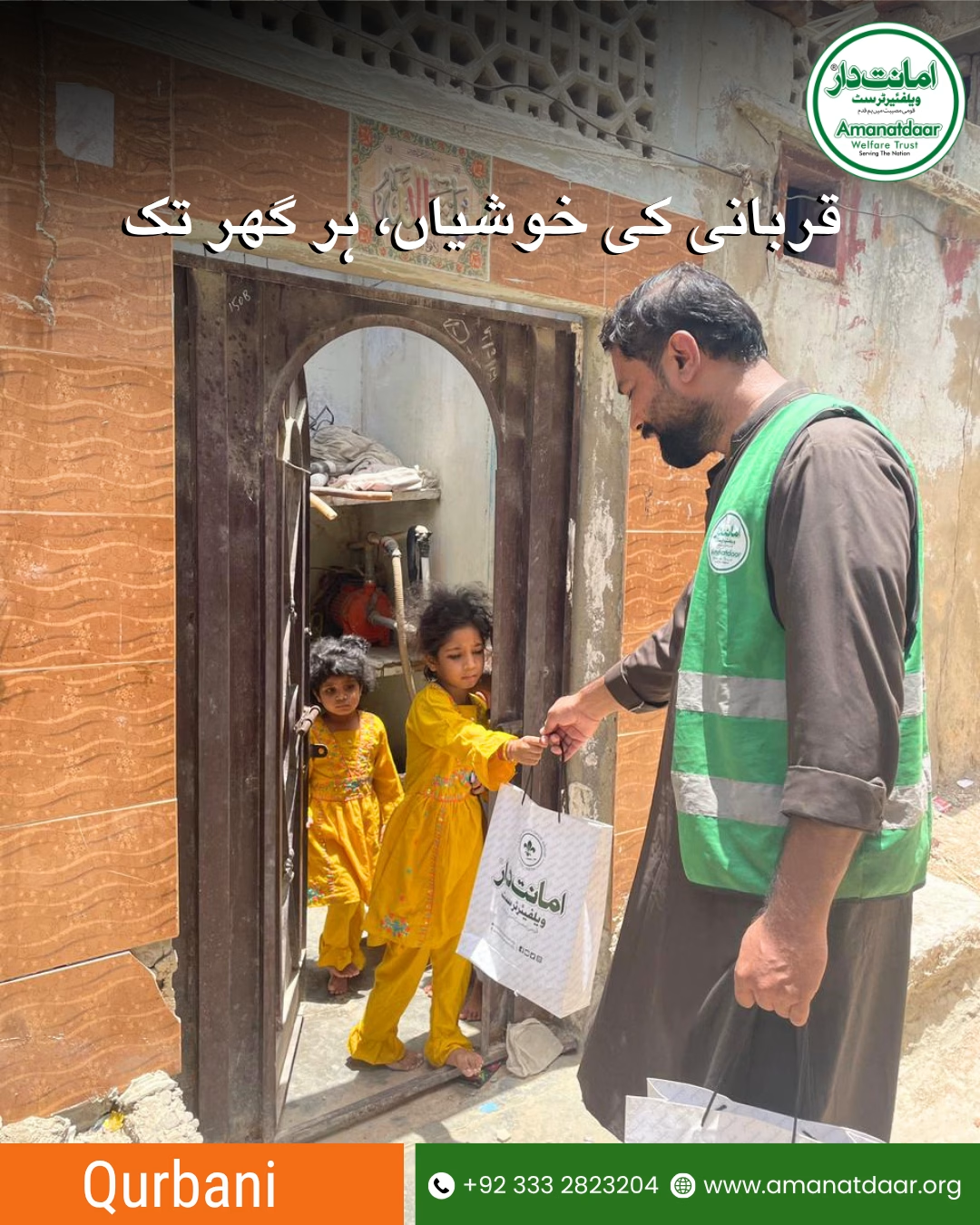
In Karachi’s informal settlements, Eid al-Adha is often the only time in the year a family eats red meat. Through its Sadaqah & Animal Sacrifice programme, Amanatdaar Welfare Trust performs Qurbani on behalf of donors in Pakistan and overseas, slaughters under supervision on the days of Eid, and distributes packed meat to verified widows, orphans and daily-wage families, alongside its year-round Dastarkhwan meals.
Perspective from Amanatdaar Welfare Trust: “A Qurbani done through us is still your Qurbani — your name is taken at the moment of sacrifice and every share is slaughtered within the three days. What changes is who eats it. As a registered trust in Pakistan, we document the animals, the slaughter and the distribution so a donor in Karachi, Dubai or Manchester knows exactly where their sacrifice went.”
—
—
![Amanatdaar volunteers distributing packed Qurbani meat to families in a low-income Karachi neighbourhood]
In the Hanafi school it is wajib — obligatory on those who hold the nisab during Eid al-Adha. Other schools consider it a confirmed sunnah. Either way, a Muslim who can afford it should not leave it.
The same threshold as Zakat — 52.5 tola of silver or 7.5 tola of gold in value — but counted on surplus assets of any kind and without the one-year condition.
Recommended before slaughter: “Inni wajjahtu wajhiya…” ending “Allahumma minka wa laka”; at the moment of slaughter: “Bismillahi Allahu Akbar”; afterwards: “Allahumma taqabbal minni.” Only the Bismillah is a condition.
Yes. Any woman who owns the nisab is personally obliged; her husband’s Qurbani does not cover her. She may appoint someone to slaughter on her behalf.
Yes, as isal-e-sawab. If it fulfils a wasiyyah they left, all the meat goes to the poor; if voluntary, the meat may be used like any Qurbani.
The Sunnah is in thirds: one for home, one for relatives and neighbours, one for the poor. Giving more to the poor is better.
Eid al-Adha 1448 is expected around 17 May 2027 in Pakistan, subject to moon sighting, with Qurbani valid until sunset on the third day.
—
Qurbani is a short act with a long reach: three days in Dhul Hijjah, a lifetime of remembering that submission to Allah came before Ibrahim’s own son. Done correctly — a qualifying animal, after the Eid prayer, with Bismillah, divided generously — it is one of the most beloved deeds of the year.
If you would like your sacrifice to feed families who otherwise would not eat meat this Eid, book it through Amanatdaar’s Sadaqah & Animal Sacrifice programme, a registered, audited trust that performs and distributes Qurbani across Karachi and Pakistan.
Subscribe to our Newsletter. We promise not to spam you!