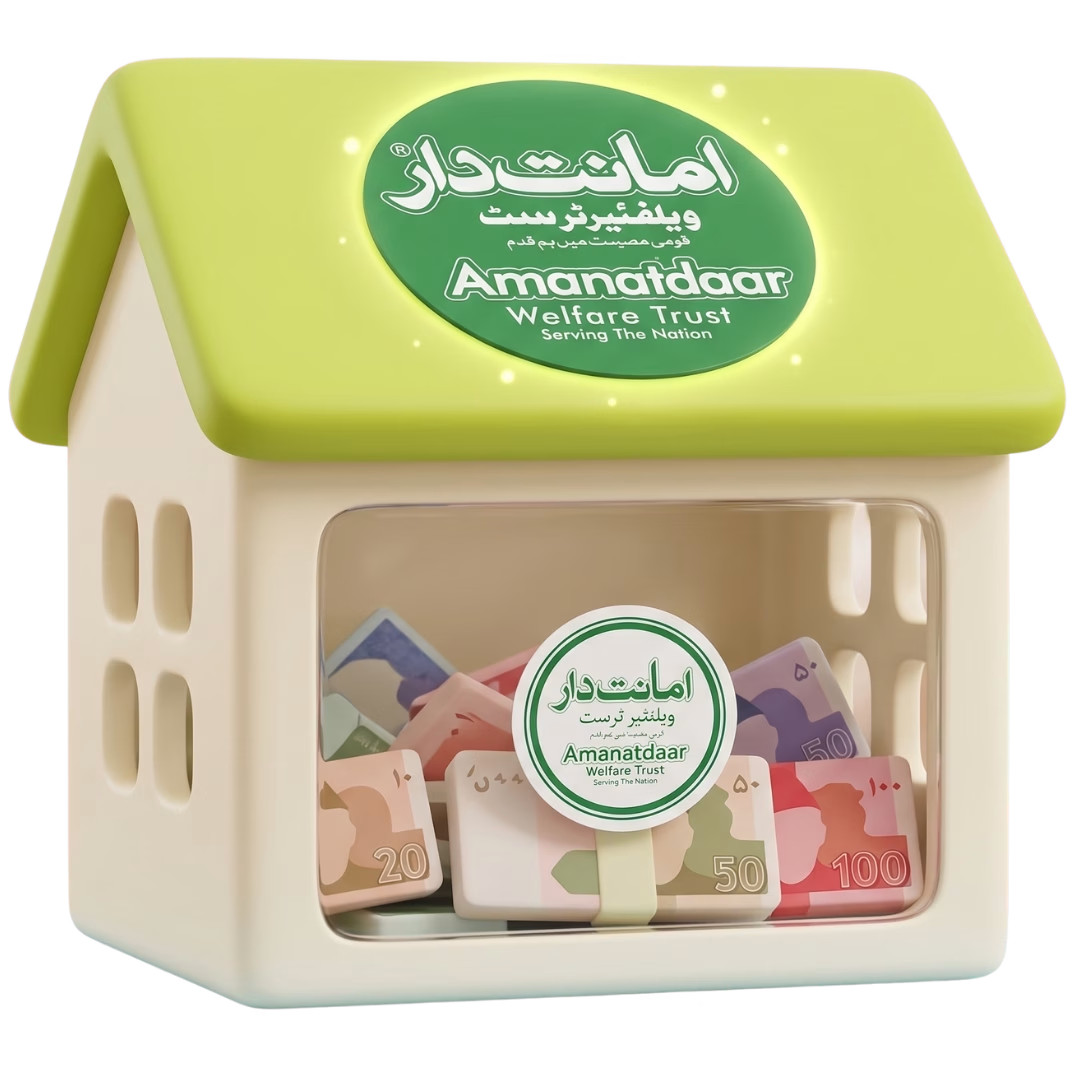
Zakat and Sadaqah are the two great engines of giving in Islam — yet they are frequently confused, even by practising Muslims. Some believe their regular donations count towards Zakat; others hold back from Sadaqah thinking Zakat is all that’s required. Understanding the difference between Zakat and Sadaqah is essential, because one is a pillar of Islam with strict rules, while the other is a boundless opportunity for reward.
This guide breaks down both concepts clearly — their meanings, rules, recipients, and rewards — so you can give each one correctly and confidently.
Zakat is the obligatory annual charity that constitutes the third pillar of Islam. Every Muslim whose wealth meets the nisab threshold (roughly the value of 612.36 grams of silver) and remains above it for one lunar year must give 2.5% of their qualifying wealth to specific categories of recipients defined in the Quran (Surah At-Tawbah 9:60).
Zakat is not optional generosity — it is the established right of the poor upon the wealth of the rich. Withholding it is a major sin, while paying it purifies both the giver’s wealth and soul.
Sadaqah comes from the Arabic root sidq, meaning truthfulness — because giving voluntarily is a proof of the sincerity of one’s faith. Sadaqah refers to any voluntary act of charity, given at any time, in any amount, to anyone.
The beauty of Sadaqah is its breadth. The Prophet (peace be upon him) taught that even a smile is Sadaqah, removing a harmful object from the road is Sadaqah, and a kind word is Sadaqah. Financially, Sadaqah can be a single rupee dropped in a donation box or a water well that serves a village for decades.
A special form of Sadaqah — Sadaqah Jariyah (ongoing charity) — continues generating reward even after the giver’s death, making it one of the most powerful investments a believer can make.
Aspect | Zakat | Sadaqah |
|---|---|---|
Ruling | Obligatory (fard) — third pillar of Islam | Voluntary (nafl) — highly encouraged |
Amount | Fixed at 2.5% of qualifying wealth | Any amount, no minimum or maximum |
Who must give | Only Muslims whose wealth exceeds nisab | Anyone, rich or poor |
Timing | Once per lunar year on your Zakat date | Any time, as often as you wish |
Recipients | Restricted to 8 categories in the Quran | Anyone in need — Muslim or non-Muslim |
Family rules | Cannot go to parents, children, spouse | Can be given to anyone, including family |
Intention | Specific niyyah of Zakat required | General intention of charity suffices |
If withheld | Sinful; remains a debt owed | No sin, but reward is missed |
Despite their differences, both share a common spirit:
While Zakat has one fixed form, Sadaqah branches into a rich variety:
This breadth means no Muslim — however limited their means — is ever excluded from the economy of giving.
Ramadan intensifies both forms of charity. The Prophet ﷺ was described as the most generous of people, and most generous of all in Ramadan — giving like “a wind unleashed.” Practical points for the blessed month:
No — and this is the most costly misunderstanding. General donations, however generous, do not discharge your Zakat obligation unless you specifically intended them as Zakat and they reached Zakat-eligible recipients. If you have been giving regularly without Zakat intention, your Zakat is still due.
The reverse is also true: once your Zakat is paid, don’t stop there. The companions of the Prophet (peace be upon him) gave far beyond the obligatory minimum, and Sadaqah is how believers race towards extra reward.
Give Zakat when:
Give Sadaqah when:
At Amanatdaar Welfare Trust, Zakat and Sadaqah funds are managed separately and deployed according to their distinct rules — Zakat strictly to verified eligible recipients, and Sadaqah flexibly wherever the need is greatest.
Your Zakat can become:
Your Sadaqah can become:
As a registered charity in Pakistan and a 501(c)(3) nonprofit in the USA, Amanatdaar provides audited transparency for every rupee and dollar — so both your obligatory and voluntary giving are honoured as a trust.
Is Sadaqah obligatory in Islam? No. Sadaqah is voluntary. However, it is strongly encouraged throughout the Quran and Sunnah, and the Prophet (peace be upon him) gave Sadaqah constantly.
Can I give Sadaqah to my parents? Yes. Unlike Zakat, Sadaqah can be given to anyone — including parents, children, and spouse. Spending on your family with the intention of pleasing Allah is itself rewarded as charity.
Which is better, Zakat or Sadaqah? Zakat takes precedence because it is obligatory — fulfilling a fard is more beloved to Allah than voluntary deeds. But the ideal believer gives both: Zakat as duty, Sadaqah as devotion.
Can Zakat and Sadaqah be given in Ramadan together? Absolutely. Many Muslims pay their annual Zakat in Ramadan for multiplied reward and add daily Sadaqah throughout the month. Just keep the intentions — and ideally the payments — distinct.
Is there a minimum amount for Sadaqah? None at all. The Prophet (peace be upon him) said: “Save yourself from the Fire even with half a date in charity” (Bukhari).
Zakat purifies what you keep; Sadaqah multiplies what you give. Together they form a complete practice of generosity that protects you in this life and testifies for you in the next.
Fulfil your Zakat through Amanatdaar’s Zakat Program, and open the door of ongoing reward with Sadaqah Jariyah — or give instantly right now through the Instant Donation Box.
Subscribe to our Newsletter. We promise not to spam you!