Winter relief in Pakistan provides blankets, quilts (razai), warm clothing and sometimes food and heating support to families who cannot afford to stay warm — especially households displaced or left with damaged homes by floods, residents of urban slums, and communities in the northern mountains where temperatures fall below freezing for months. The need is not seasonal inconvenience; it is a health emergency. In January 2024, Punjab alone registered more than 18,000 child pneumonia cases and nearly 300 deaths in a single month during a cold, dry winter. A warm blanket costs little, but for a newborn sleeping on a cold floor, it can be the difference between a hard winter and a fatal one.
Pakistan’s winter is often imagined as mild. For families without insulation, heating, or even proper walls, it is anything but.
Cold, smog and malnutrition combine to make children highly vulnerable to respiratory infection. During the winter of 2024, Punjab recorded more than 18,000 pneumonia cases and close to 300 deaths in January alone, and the provincial government extended school holidays and mandated masks to protect children. UNICEF has noted that roughly half of childhood pneumonia deaths are associated with air pollution — a danger made far worse when children sleep cold.
Each monsoon leaves thousands of families entering winter without a proper roof. According to the National Disaster Management Authority, the 2025 monsoon floods killed more than 1,000 people across Pakistan by late September and affected over 12,500 homes, with more than 4,000 completely destroyed. After the catastrophic 2022 floods, UNICEF warned that nearly 10 million children were heading into a bitter winter without adequate shelter. Rebuilding takes years; winter arrives every December.
The World Bank estimates that 25.3% of Pakistanis lived below the national poverty line in 2024-25. For these households, gas cylinders, heaters and even second-hand quilts compete with food and rent. When budgets break, warmth is usually the first thing to go.
Families living in tents, partially repaired homes or with relatives after floods have the least protection from cold nights and damp ground.
In parts of Khyber Pakhtunkhwa, Gilgit-Baltistan, upper Punjab and northern Balochistan, temperatures fall well below zero. Without warm bedding and clothing, the elderly and infants are at serious risk.
In Karachi, Lahore and other cities, daily-wage workers and families in katchi abadis live in homes of tin, cloth or unfinished brick. Cold nights are harsher than many expect, and the homeless sleep with almost nothing.
Those who cannot work, cannot travel to collect aid, or cannot regulate their own body temperature are the most vulnerable of all. Women-headed households supported through widow support programmes are often among the first to receive winter kits.
Item | Why It Matters | Who It Protects Most |
Thick blanket or quilt (razai) | Prevents heat loss during sleep, the coldest hours | Infants, elderly, everyone |
Floor mat or sleeping mattress | Stops cold rising from bare or damp ground | Families in tents and flood-damaged homes |
Children’s warm clothing (jacket, cap, socks) | Children lose heat faster than adults | Under-fives most at risk of pneumonia |
Shawl or sweater for women and elders | Protection during the day as well as night | Widows, elderly, nursing mothers |
Food ration pack | Calories help the body generate warmth | Households cutting meals to afford fuel |
Basic medicines and referrals | Early treatment of chest infections | Children with cough and fever |
The exact contents vary by region and budget. In the coldest mountain areas, heavier bedding and warm clothing matter most; in flood camps, mats and waterproofing come first. Pairing kits with food rations or a visit from a free mobile clinic multiplies their impact.
The best time to donate for winter relief in Pakistan is October and November, before the coldest weeks of December to February. Donations made early allow charities to buy blankets and clothing at lower pre-season prices, pack kits, and reach remote areas before snow blocks mountain roads. Donations made in January still save lives — need peaks then — but every early rupee stretches further.
Field teams and local volunteers list households based on poverty, displacement, number of young children and elderly members, and exposure to cold.
Lists are checked to avoid duplication and to make sure the most vulnerable — infants, the elderly, widows and the sick — are reached first.
Blankets, quilts and clothing are bought in bulk before peak season to secure quality and lower prices.
Kits are packed according to family size and climate zone, so a family of seven in the mountains receives more than a couple in Karachi.
Distribution is organised by token or door-to-door delivery, so no one has to queue for hours in the cold or compete in a crowd.
Teams note families who need further support — medical care, rations, or shelter repair — and refer them to other programmes.
—
Yes. Blankets, clothing and rations given into the ownership of poor and needy Muslim families are a valid use of Zakat under the categories of the fuqara and masakin (Surah At-Tawbah, 9:60). Sadaqah can be used for everyone in need, regardless of faith or eligibility. If you are unsure which to use, our guide on the difference between Zakat and Sadaqah explains the rules.
The Prophet ﷺ taught that whoever clothes a believer in need, Allah will clothe him from the garments of Paradise — a hadith recorded by Abu Dawud and at-Tirmidhi. In a Pakistani winter, a warm blanket is that garment.
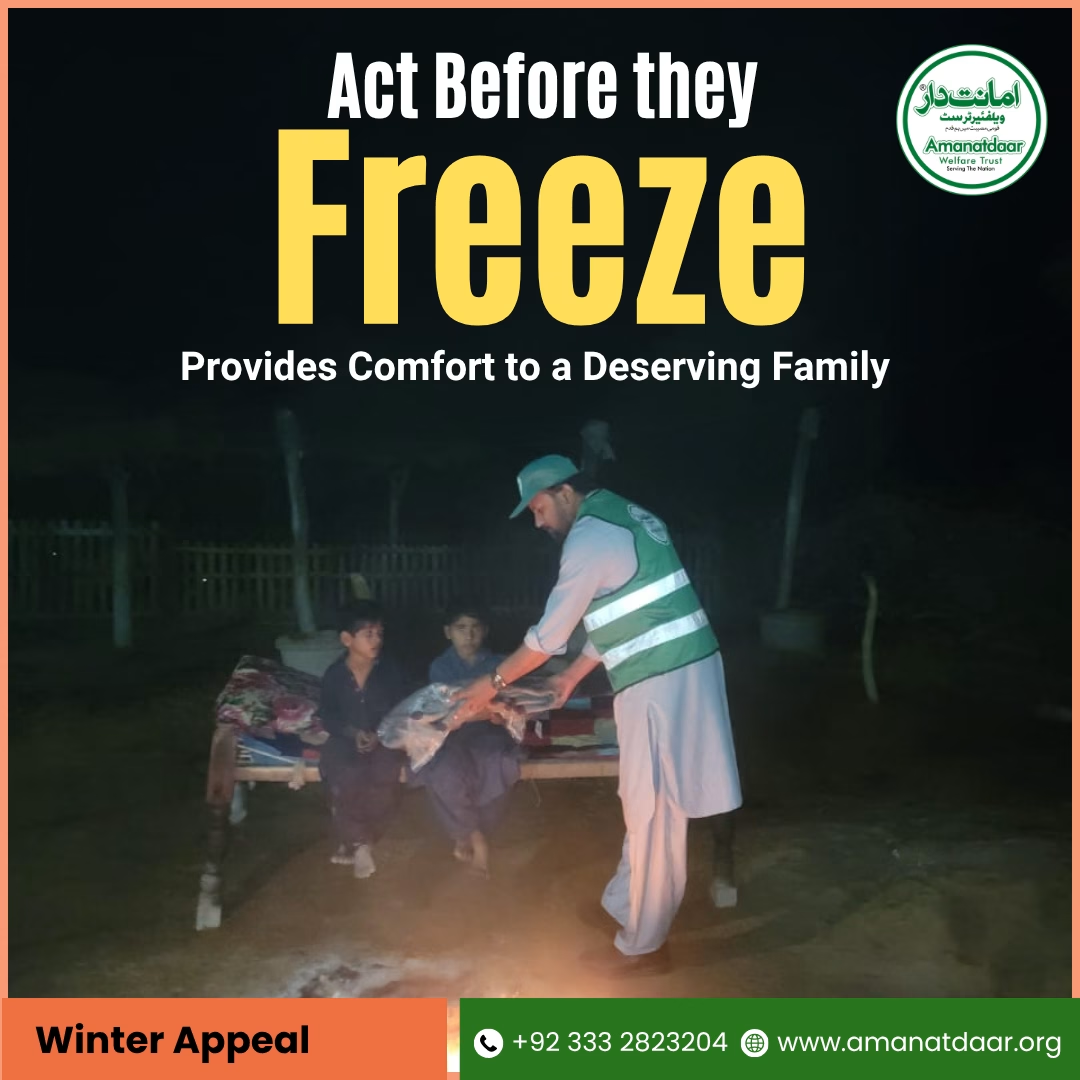
Amanatdaar Welfare Trust distributes blankets to underprivileged families each winter as part of its relief work, alongside its year-round food, health and widow support programmes. Through its emergency appeal, the trust’s crisis-response team works with regional volunteers to deliver essentials quickly and transparently to families hit by floods, disasters and harsh conditions.
Perspective from Amanatdaar Welfare Trust: “Every winter we meet families who have spent the whole night awake keeping their children warm with whatever cloth they have. A single blanket changes that night. We buy early, verify every household, and deliver to people’s doors so no mother has to stand in a queue in the cold with a baby in her arms. As a registered NGO in Pakistan, we report on every distribution so donors know exactly where their blankets went.”
Winter relief is the provision of blankets, quilts, warm clothing, mats and often food and basic medical help to poor and displaced families during Pakistan’s cold months. It protects children and the elderly from hypothermia and respiratory illness.
October and November are the best months, because charities can buy supplies at lower prices and reach remote areas before roads close and temperatures peak. Donations in December and January are still urgently needed.
Yes. Blankets and warm clothing given into the ownership of eligible poor or needy Muslims are a valid use of Zakat. Sadaqah can be used for anyone in need.
The coldest mountain areas of Khyber Pakhtunkhwa, Gilgit-Baltistan, upper Punjab and northern Balochistan, flood-affected districts across Sindh, Punjab and KP, and informal settlements in large cities such as Karachi and Lahore.
Cold weakens children’s immunity and makes them vulnerable to pneumonia, especially when combined with malnutrition, smog and lack of vaccination. Families without bedding or heating cannot protect infants during freezing nights.
Money is usually better. Charities buy in bulk at lower prices, choose items suited to each region, and handle transport and distribution. Donated household blankets are welcome locally but are harder to deliver to remote areas.
Yes. Amanatdaar accepts donations online from abroad, including through its US-registered 501(c)(3) affiliate, YL Charity Inc.
Every winter, the same families face the same impossible maths: food, fuel or warmth — choose two. For a widow in a flood-damaged home or a labourer’s family in a tin shelter, a blanket is not a gift; it is protection for the most fragile people in the house.
The cost is small and the timing matters. Give before the cold arrives, and your Zakat or Sadaqah will be wrapped around a child on the first freezing night.
To keep a family warm this winter, give through Amanatdaar’s emergency appeal and help the trust reach Pakistan’s coldest, poorest households before the worst weeks arrive.
Subscribe to our Newsletter. We promise not to spam you!