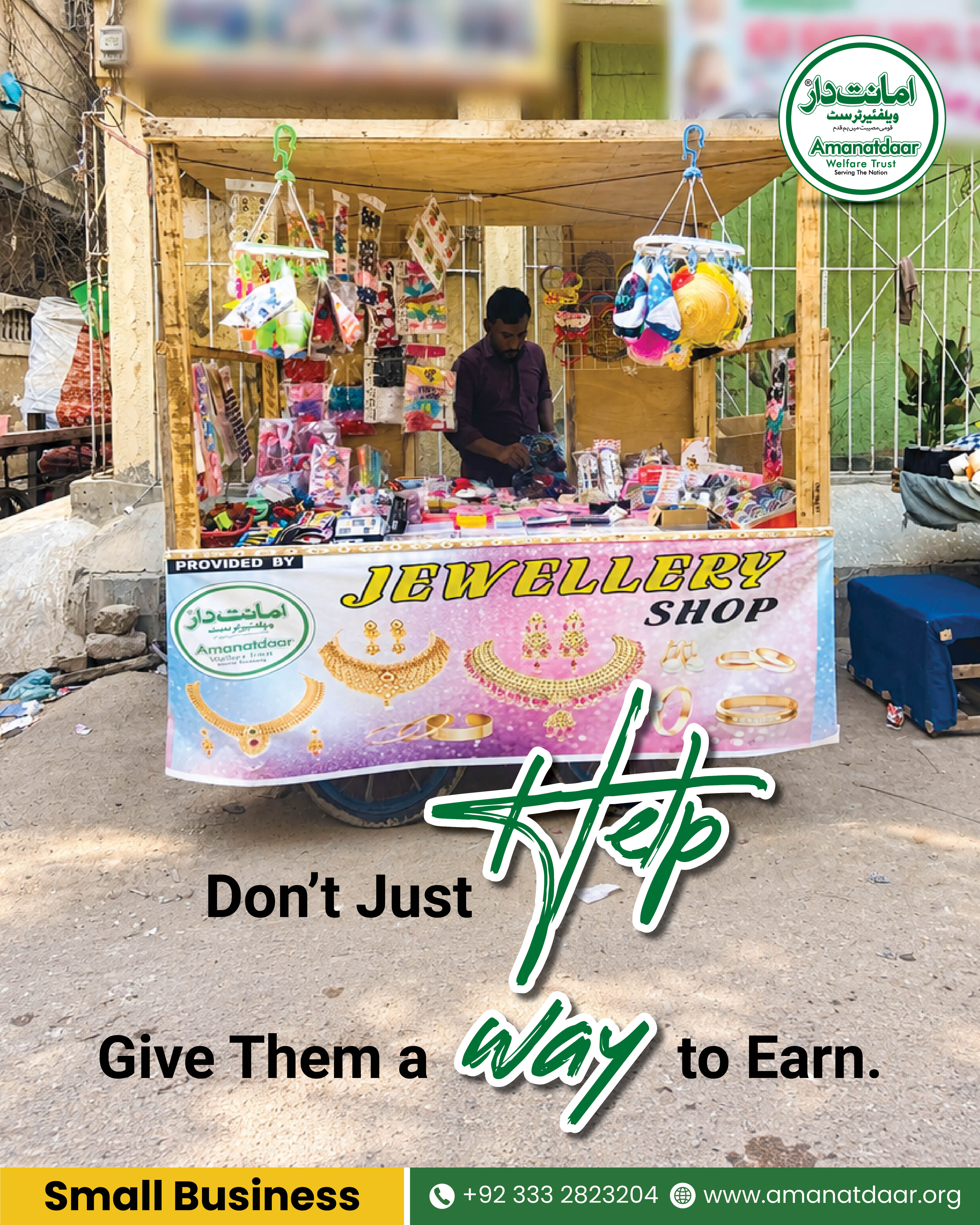
Small business support in Pakistan gives a low-income person the tools, equipment or starting stock they need to earn a living on their own — a sewing machine for a widow, a pushcart for a street vendor, vegetable stock for a stall, or tools for a mechanic. Instead of receiving monthly aid indefinitely, the family builds an income that grows. It follows a Prophetic model: when a poor man asked the Prophet ﷺ for charity, he helped him buy an axe so he could earn by cutting wood. Zakat can fund small business support when the tools or stock are given into the ownership of an eligible recipient, making it one of the most powerful ways to turn a one-time donation into lasting self-reliance.
Food rations and cash help keep families alive in a crisis. But for millions of Pakistani households, the crisis is permanent: there simply is no job.
According to the Pakistan Bureau of Statistics Labour Force Survey 2024-25, unemployment rose to 7.1%, the highest in over two decades, with around 5.9 million people unemployed. Female unemployment stood at 10.5%, and Khyber Pakhtunkhwa recorded the highest provincial rate at 9.6%. Roughly 3.5 million people enter the labour force every year, far more than the formal economy can absorb.
The jobs that do exist are mostly informal: 72.1% of non-agricultural employment is in the informal sector, with no contracts, no protection and unstable income. At the same time, the World Bank reports that 25.3% of Pakistanis lived below the national poverty line in 2024-25.
In this environment, self-employment is not a lifestyle choice — it is often the only realistic path out of poverty. The Pakistan Economic Survey 2025 itself highlights community-driven poverty graduation models as a key to sustainable poverty reduction. What most aspiring entrepreneurs lack is not skill or willingness, but a few thousand rupees of starting capital.
Anas ibn Malik narrated, in a hadith recorded by Abu Dawud, that a man from the Ansar came to the Prophet ﷺ asking for charity. The Prophet ﷺ asked what he owned. The man had a blanket and a drinking bowl. The Prophet ﷺ auctioned them for two dirhams, told the man to spend one on food for his family and use the other to buy an axe. The Prophet ﷺ fixed a handle to it himself and told the man to go and gather wood and sell it, and not to return for fifteen days. When he came back, he had earned ten dirhams.
The lesson has shaped Islamic charity for fourteen centuries: the best help restores a person’s ability to provide for themselves with dignity. Small business support is that axe, adapted for Karachi’s streets and Pakistan’s villages.
Candidates are usually referred through community networks, existing beneficiaries of food or widow support, or local volunteers. Priority goes to households with dependents and no stable earner.
A grant only works if the business suits the person and the market. A skilled tailor in a neighbourhood without one, or a fruit vendor near a busy bus stop, has a real chance of success.
The plan answers practical questions: what will be sold, to whom, at what margin, and how much daily income is realistic. It does not need to be written in formal language — it needs to be honest.
Rather than giving cash, the charity buys the sewing machine, cart, stock or tools at fair prices and hands them over. This protects the grant from being diverted to urgent household bills.
The equipment becomes the recipient’s property. For Zakat-funded grants, this transfer of ownership is what makes the Zakat valid.
Simple advice on pricing, saving a portion of daily earnings, and restocking makes a large difference in the first months.
Visits after three and six months check whether the business is running, whether income has stabilised, and whether the family still needs other support.
Business | Typical Assets Provided | Often Suits |
Home tailoring | Sewing machine, fabric, thread | Widows and women who need to work from home |
Fruit or vegetable cart | Pushcart (thela) and initial stock | Men with street-selling experience |
Small grocery or kiryana kiosk | Shelving and starting stock | Families with a room facing the street |
Food stall | Stove, utensils, initial ingredients | Those with cooking skills near busy areas |
Mobile repair or electrician | Toolkit and spare parts | Young men with technical training |
Livestock rearing | Goats or poultry | Rural families with space and fodder access |
Embroidery and handicrafts | Frames, materials | Women with traditional skills |
The best choice is always the one that matches the person’s skills, health, location and family responsibilities — not the one that looks most impressive in a photo.
Feature | Livelihood Grant | Qarz-e-Hasna | Commercial Microfinance |
Repayment required | No | Yes, without interest | Yes, with interest or markup |
Best for | The poorest with no savings or credit | People with some income who need capital | Established micro-businesses |
Zakat-eligible | Yes, if ownership passes to an eligible recipient | No (it is a loan) | No |
Risk to recipient | None | Low | Debt stress if business fails |
For a widow with no income, an interest-free loan can become a burden; a grant gives her a start with no strings. For a vendor who already earns but needs to expand, Qarz-e-Hasna may be the better tool.
Yes. Giving Zakat to a poor or needy Muslim in the form of tools, equipment or stock that becomes their property is valid, because ownership passes to an eligible recipient (Surah At-Tawbah, 9:60). Many scholars consider this among the most beneficial uses of Zakat, since it can lift the recipient above the level of needing Zakat in future years — the ultimate goal of the system.
Amanatdaar’s Zakat programme already directs Zakat to small business setups such as sewing machines and pushcarts, alongside food, education, healthcare and water. Business owners calculating their own obligation may find our guide to Zakat on business assets useful.
Women face the steepest barriers in Pakistan’s job market — female unemployment of 10.5% understates the problem, because millions of women are not counted as seeking work at all. Mobility restrictions, childcare duties and social norms mean many cannot take outside jobs.
Home-based businesses — tailoring, embroidery, food preparation, small retail from home — fit within these realities. For widows supported through widow support, a sewing machine can turn monthly assistance into a growing income while she stays with her children.
Amanatdaar Welfare Trust’s small business support programme encourages entrepreneurship among underprivileged families by providing resources, training and startup support, helping families overcome poverty and build a better future for generations to come. Individual appeals — such as helping Adnan and Asad each start a small business — are published on the trust’s website, so donors can follow the people they help.
Perspective from Amanatdaar Welfare Trust: “The most powerful moment in our work is when a family that once came to us for rations comes back to tell us they no longer need them. A pushcart, a sewing machine, a few weeks of stock — these are small things to a donor, but to a family they are a future. We choose businesses carefully, buy the equipment ourselves, and follow up, because a livelihood that lasts is the best Amanah we can return to our donors.”
—
![A Pakistani family gathered at their small grocery kiosk started with a Zakat-funded grant]
Small business support is a charity programme that gives low-income individuals the equipment, tools or starting stock to run their own small business — such as a sewing machine, a pushcart or grocery stock — so they can earn a regular income.
Yes. If the recipient is eligible for Zakat and the tools or stock are given into their ownership, it is a valid and highly beneficial use of Zakat, because it helps them become self-sufficient.
Costs vary by business type. A basic sewing machine or pushcart setup costs far less than a stocked kiosk or livestock. Contact Amanatdaar for current amounts for each type of livelihood package.
For the poorest families with no savings or steady income, a grant is usually safer because it carries no repayment risk. For people with some income who need capital to expand, an interest-free loan (Qarz-e-Hasna) can work well.
Businesses that match the recipient’s skills and local demand do best — tailoring for skilled women, fruit and vegetable carts in busy areas, small grocery kiosks, food stalls, repair work and livestock in rural areas.
Well-run programmes buy the equipment directly instead of handing over cash, transfer ownership to the recipient, and conduct follow-up visits to check the business is operating and the family is progressing.
Yes. Amanatdaar publishes individual small business appeals on its website, so donors can sponsor a named person and follow their progress.
Charity that feeds a family today is a mercy. Charity that lets a family feed itself for years is a transformation. Pakistan’s labour market cannot absorb everyone who needs work — but with a few tools and a little stock, many can create work for themselves.
Small business support follows the example the Prophet ﷺ set with a single axe: restore a person’s ability to earn, and you restore their dignity along with their income.
To give a deserving family the tools to build their own livelihood, donate your Zakat or Sadaqah to Amanatdaar’s small business support programme.
Subscribe to our Newsletter. We promise not to spam you!