Qarz-e-Hasna (قرضِ حسنہ) — also written Qard al-Hasan in Arabic — is an interest-free benevolent loan rooted in Quranic commandment: the borrower repays only the principal, with no markup, no hidden fee, and no penalty for hardship. In Pakistan today, this fourteen-century-old principle powers the largest Islamic microfinance movement on earth, lifting millions of low-income families out of debt traps without violating a single rule of Shariah.
If you are searching for what Qarz-e-Hasna means, whether it is halal, how it differs from Zakat, who qualifies, or how your donation funds it — every answer is on this page.
Every authentic Qarz-e-Hasna programme traces its legitimacy to direct Quranic address, not to scholarly opinion alone.Continuing exactly where the article stopped:
The word qardh appears in the Quran in six verses: Q2:245, Q5:12, Q57:11, Q57:18, Q64:17, and Q73:20. In every verse it is used as part of the phrase qardh al-hasan, and always in reference to a loan to Allah rather than other human beings.
Three of those verses speak with particular directness:
It is called a “loan” not because Allah is in need — exalted is He above all need — but as a metaphor of honour, assurance, and guaranteed recompense. The theological logic is straightforward: when you lend to a person in need, you are in reality lending to Allah, who guarantees the return multiplied.
Sayyiduna Anas ibn Malik (radiyallahu ‘anhu) reports that Rasulullah ﷺ said: “On the night of Mi’raj, I saw written at the gate of Jannah, ‘Charity brings a tenfold reward and a loan brings [an eighteen-fold reward].'” (Sunan Ibn Majah, Hadith 2431) The angel explained this by saying: “Because [the] beggar who asked had already had something, but a loanee did not ask for a loan unless he was in need.” [Ibn Hisham and Ibn Majah]
The Prophet ﷺ also modelled the ethic personally. As recorded in Ibn Majah, he took a camel of a particular age on loan, gave back a camel of a better age than the one he was given, and said: “The best among you is the best in repaying.”
These are not peripheral narrations. They are the direct scriptural engine behind every major Qarz-e-Hasna programme operating in Pakistan today.
Qarz-e-Hasna is a loan on which zero interest is charged, zero markup is added, and the borrower repays only the principal amount they received.
Scholar M. Umer Chapra defines Qard al-Hasan as “a loan which is returned at the end of the agreed period without any interest or share in the profit or loss of the business.” It is a gratuitous loan given to needy people for a fixed period without requiring payment of interest or profit. The receiver is only required to repay the original amount of the loan.
What it is not:
Qard Hasan can be seen as something between giving charity and giving a loan. The borrower receives dignity — not a handout — and the lender’s capital returns to help the next person in need.
This is the most-searched confusion among Pakistani donors and beneficiaries alike. Here is the cleanest way to hold all three apart:
Qarz-e-Hasna | Zakat | Sadaqah | |
Nature | Interest-free loan | Obligatory charity | Voluntary charity |
Repaid? | Yes — principal only | No | No |
Shariah obligation | Highly recommended (mustahabb) | Obligatory (fard) on nisab-holders | Voluntary (nafl) |
Who benefits | Borrower retains agency; repays and moves on | Specific 8 categories (asnaf) in Quran | Anyone in need |
Donor reward | Multiplied — hadith says 18× | Purifies wealth; specific fard reward | 10× minimum return |
Fund recycling | Yes — same money helps multiple families | One-time disbursement | One-time disbursement |
The critical practical point: Zakat and Sadaqah donations can be channelled into a Qarz-e-Hasna revolving fund, meaning your single act of giving multiplies across many families over time. Whether Zakat money can be used directly as the capital for interest-free loans is a matter of scholarly discussion — most Pakistani scholars permit it when the loan is given to Zakat-eligible recipients — but in most programmes Zakat and Sadaqah together form the pool from which loans are disbursed.
Eligibility principles are consistent across Pakistani programmes, even though the exact income thresholds vary by organisation.
The common criteria are:
Women, youth, and daily-wage earners receive priority weighting across all major programmes. In Karachi and Sindh, urban slum residents and home-based workers — particularly women running small tailoring, food, or retail enterprises from their homes — form the core eligible demographic.
Akhuwat Foundation, established in 2001, is the world’s largest interest-free microfinance institution. Operating over 800 branches across Pakistan, it has disbursed over PKR 220 billion in Qarz-e-Hasna (interest-free loans) to more than 6 million families.As of 2024, its Islamic Microfinance program reported a repayment rate of 99.9%. Business loans range from PKR 10,000 to PKR 650,000, enabling recipients to initiate or expand small businesses. Loan repayments to Akhuwat are again utilised to help out the next needy person — a revolving model that means every rupee donated works far harder than a one-time grant.
Akhuwat was founded in line with the Islamic principle of Mawakhat (brotherhood). The earliest example of this concept is traced to the solidarity between the citizens of Medina and the Muhajireen (Meccan migrants) who settled there after fleeing persecution, when resources were shared between the two groups.
The Microfinance (AKIM) programme is based on the Islamic principle of Qarz-e-Hasna, which encourages Muslims to help those in need with interest-free loans. Through the programme, Alkhidmat Foundation Pakistan aims to promote this principle as a viable model for poverty alleviation and to institutionalise the spirit of brotherhood.
Initial financial assistance starts from PKR 30,000 to PKR 75,000 for a short span, according to Alkhidmat Karachi’s CEO (Business Recorder, March 2024). The programme provides social guidance, capacity building, and entrepreneurial training to its beneficiaries, enabling them to become self-reliant and financially stable. AKIM specifically includes a loan category for orphans’ mothers — one of the most financially invisible groups in urban Sindh.
The Ihsan Trust Qarz-e-Hasna loan provides interest-free financing to deserving students. It covers tuition fees, hostel expenses, and academic supplies for students enrolled in HEC-recognised universities. Ihsan Trust is the only organisation in Pakistan helping and assisting students without any discrimination of social background, age, religion, income level, and government basic salary restrictions. Repayment is structured in affordable monthly instalments that begin as a token amount during the student’s study period and increase after graduation.
The Ehsaas Interest-Free Loan (Qarz-e-Hasna) Programme continues in 2025 as one of Pakistan’s largest microfinance initiatives, providing financial support to low-income individuals, women entrepreneurs, and unemployed youth. Backed by the Pakistan Poverty Alleviation Fund (PPAF) and implemented through partner organisations, the scheme offers loans from PKR 50,000 to PKR 200,000 without charging any interest.
The programme sets 0% markup (Qarz-e-Hasna), with a special quota of 50% for women and 25% for youth, and a repayment period of 1 to 2 years in flexible instalments.
Programme comparison at a glance:
Programme | Loan Range | Primary Focus | Key Feature |
Akhuwat Foundation | PKR 10,000–650,000 | Small business, housing, education | World’s largest; 99.9% repayment |
Alkhidmat AKIM | PKR 30,000–75,000 (entry) | Small business, women, orphan mothers | Entrepreneurial training included |
Ihsan Trust | Tuition-linked | University students | No income/background restrictions |
Ehsaas / PPAF | PKR 50,000–200,000 | Micro-entrepreneurs, women, youth | 50% quota for women |
A one-time grant disappears the moment it is spent. A revolving Qarz-e-Hasna pool does not.
When a donor pays Zakat or gives Sadaqah into a properly structured interest-free loan fund, that capital is lent to a family in need. The family repays the principal over 12–24 months. That same principal is then lent to the next family. Over a ten-year period, a single PKR 50,000 donation can theoretically cycle through five or more families — each time lifting a household, each time returning to help another.
Every loan comes from donations and Zakat funds contributed by generous citizens. When one borrower repays their amount, it is re-used to help another — creating a continuous cycle of kindness.
This is the multiplier effect that distinguishes Qarz-e-Hasna from conventional charity. The borrower’s dignity is preserved because they are not receiving a handout. The donor’s barakah is multiplied because the same rupees keep doing good. And the community’s economic fabric strengthens because productive micro-enterprises — a tailoring shop in Lyari, a small grocery in Orangi Town, a mobile repair stall in Korangi — generate income that circulates locally.
Repayment rates consistently exceeding 99.8% are sustained annually without exception through normative community enforcement rather than coercive mechanisms, enabling rapid loan recycling. This is not accidental. Loans disbursed inside mosques and community centres, in front of neighbours and guarantors, create a moral architecture that commercial banks cannot replicate.
The dominant position among Pakistani scholars is that Zakat funds may be used for Qarz-e-Hasna programmes provided the loan recipients belong to one of the eight Quranic categories of Zakat eligibility (the asnaf) and that ownership of the funds transfers to the recipient at disbursement. On this basis, organisations like Akhuwat and Alkhidmat AKIM accept Zakat and Sadaqah into their revolving pools. Donors who are unsure about their specific circumstances should consult a qualified scholar, but the broad practice is well-established across Pakistan.
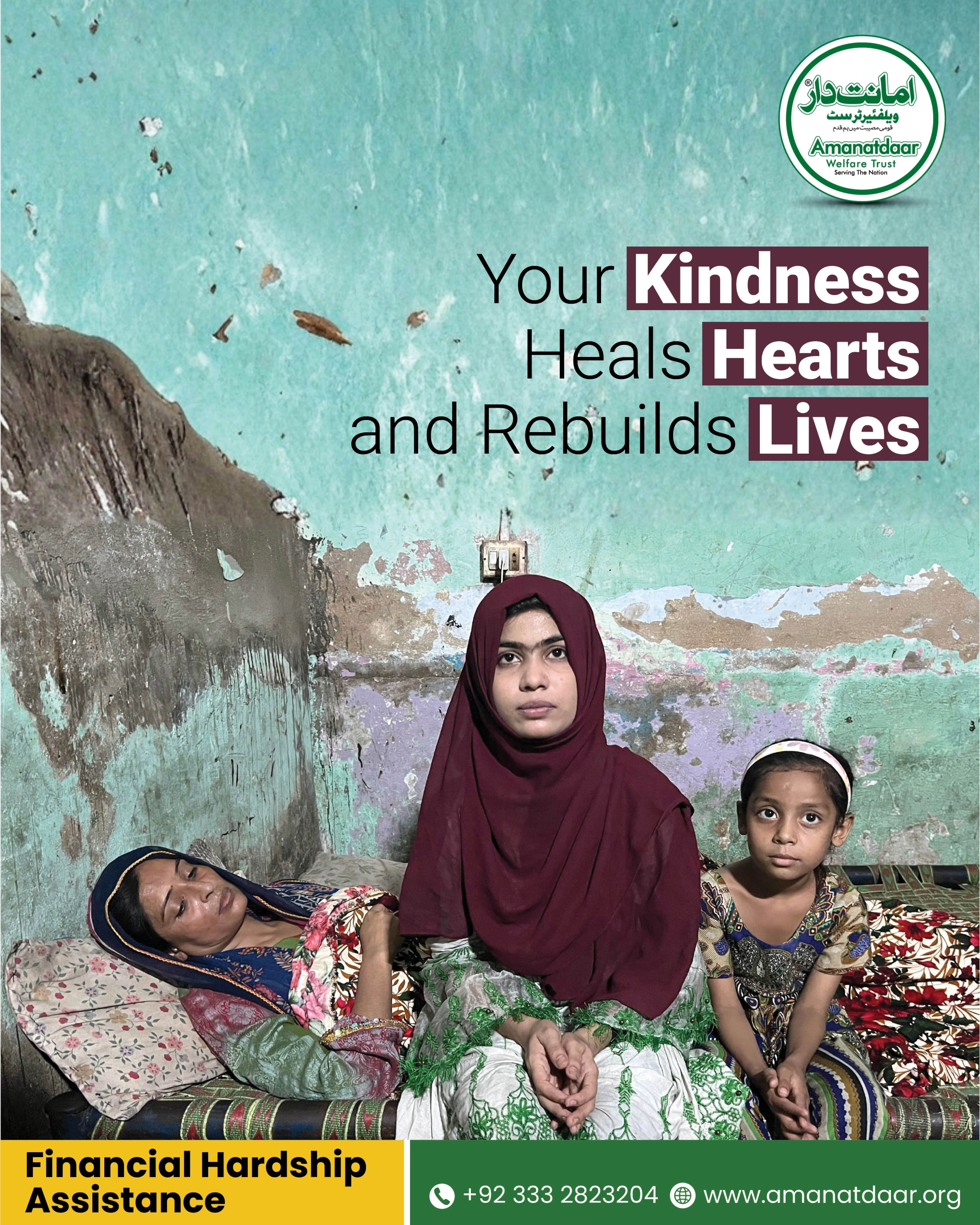
Nadia is a thirty-four-year-old widow living in Orangi Town, one of Karachi’s largest low-income settlements. Her husband passed away three years ago, leaving her with two school-age children and no steady income. She had the skill — years of stitching clothes for neighbours — but no capital to buy a second sewing machine and the fabric stock that would let her take on bulk orders for school uniforms.
A community welfare organisation connected her to an interest-free microfinance programme. She received a PKR 35,000 loan, repayable over eighteen months in small instalments she could manage around her work schedule. Within four months her workshop had two machines running. By month twelve she had hired a part-time helper and was supplying a small school in the area. She repaid her full loan on time.
That PKR 35,000 did not disappear. It returned to the fund — and within weeks it was in the hands of the next woman in Orangi Town who needed it.
Stories like Nadia’s repeat across Karachi’s katchi abadis, across the flood-hit districts of interior Sindh, and across hundreds of small towns where formal banks have never opened a branch. The widow support Pakistan need alone is vast: millions of women head households with no collateral, no credit history, and no path to conventional finance.
Amanatdaar Welfare Trust is a registered Karachi-based nonprofit that channels Zakat, Sadaqah, and general donations into food, education, healthcare, clean water, widow support, and emergency relief for underprivileged communities across Pakistan.
Within its livelihood portfolio, Amanatdaar’s small business support Pakistan programme provides micro-enterprise assistance to low-income families — the same population that Qarz-e-Hasna is designed to serve. The Trust operates on the principle that sustainable poverty relief requires more than a one-time food parcel. A family that receives a productive livelihood intervention — whether a sewing machine, a cart, stock for a small shop, or a Qarz-e-Hasna-style interest-free advance — can escape the cycle of dependency entirely.
As a registered NGO Pakistan with full transparency over fund allocation, Amanatdaar ensures that every rupee of Zakat reaches Zakat-eligible recipients and every rupee of Sadaqah is deployed where it generates the longest-lasting impact. Donors who pay Zakat in Pakistan through Amanatdaar can be confident their obligation is fulfilled through a verified, accountable channel — not a nameless intermediary.
Beyond livelihoods, the Trust’s charity programmes Pakistan span:
Perspective from Amanatdaar Welfare Trust: “The spirit of Qarz-e-Hasna is the spirit of Amanat — trust. When a donor places their Zakat or Sadaqah with us, they are placing a trust. When a beneficiary receives a loan or livelihood grant, they too carry a trust — to use it well and to pass the barakah forward. Our work is to honour both sides of that covenant. A community that can feed itself, educate its children, and run its own small enterprise does not need charity forever. That is the goal.”
Donors who wish to give Sadaqah Jariyah Pakistan — ongoing charity whose reward continues after death — will find that funding a revolving livelihood fund is among the most powerful forms of Sadaqah Jariyah available, because the same capital keeps generating benefit long after the initial gift.
Qarz-e-Hasna (قرضِ حسنہ) means “a beautiful loan” or “a benevolent loan” in Arabic and Urdu. It is an Islamic concept of interest-free lending, based on the principle of helping others without expecting a financial gain. The borrower repays only the exact principal they received. The lender earns no material return — their reward is with Allah, who the Quran promises will multiply it many times over.
Yes, Qarz-e-Hasna is not only halal but actively encouraged — it is mentioned in six verses of the Quran and praised in multiple hadith. The Prophet ﷺ said: “The best person among you is the one who fulfils his obligation (loan) in a good manner.” If an increase or premium is made a condition, then that is haram (unlawful), and it is riba (interest) as well. The halal status depends entirely on the absence of any pre-conditioned increase — which is the defining feature of every legitimate Qarz-e-Hasna programme.
Qarz-e-Hasna is a loan — the principal must be returned. Zakat and Sadaqah are gifts — nothing is returned to the donor. Zakat is obligatory on nisab-holding Muslims and must reach one of eight Quranic categories of recipients. Sadaqah is voluntary and can go to any person in need. Both Zakat and Sadaqah can be used to fund a Qarz-e-Hasna revolving pool, meaning your charitable giving can keep recycling through multiple families rather than ending with one.
Eligibility principles are consistent across major programmes. You generally need: a valid CNIC, age between 18 and 62, a demonstrable low-income status or inability to access formal bank credit, a productive purpose for the loan (business startup or expansion, education, housing), two non-family community guarantors, and — for the Ehsaas scheme — a poverty score of up to 40. Daily wage earners, labourers, and unemployed individuals are eligible. Women and youth receive priority weighting across all programmes.
The four major providers are: Akhuwat Foundation (PKR 10,000–650,000, nationwide, world’s largest); Alkhidmat AKIM (initial loans from PKR 30,000 to PKR 75,000, with focus on small business and women); Ihsan Trust (education-linked, for university students regardless of background); and the Ehsaas Qarz-e-Hasna Scheme backed by PPAF (PKR 50,000 to PKR 200,000, zero interest, with a 50% quota for women). Smaller welfare trusts like Amanatdaar also channel funds into livelihood and micro-enterprise support.
Collect your CNIC, proof of residence, and a basic business plan. Identify two non-family guarantors from your community. Both online and offline applicants are accepted across most programmes. For Akhuwat, visit the nearest of their 800-plus branches. For Ehsaas, visit the official website of the Pakistan Poverty Alleviation Fund at ppaf.org.pk, search your district or Union Council name, and find your nearest loan centre. Processing typically takes two to four weeks from application to disbursement.
Akhuwat Foundation, established in 2001, is the world’s largest interest-free microfinance institution. Operating over 800 branches across Pakistan, it has disbursed over PKR 220 billion in Qarz-e-Hasna loans to more than 6 million families. Rooted in Islamic principles of brotherhood and compassion, Akhuwat empowers marginalised communities without collateral requirements. Business loans range from PKR 10,000 to PKR 650,000. The repayment rate is 99.9%. Loans are typically disbursed at mosque gatherings to reinforce community accountability and transparency.
The dominant scholarly position in Pakistan permits Zakat funds to be channelled into Qarz-e-Hasna pools, provided the loan recipients are from the eight Quranic categories of Zakat eligibility and that ownership of the disbursed amount transfers fully to the recipient. Your Zakat and Sadaqah can bring hope to families in need, empowering them to become self-sufficient. Donors uncertain about their specific situation should consult a qualified scholar. Amanatdaar Welfare Trust ensures all Zakat disbursements reach verified eligible recipients and maintains full accountability records for donors.
Qarz-e-Hasna is Islam’s answer to the debt trap — a financial instrument grounded in Quranic command, proven at national scale, and capable of transforming a single donation into a decade of revolving impact. It is halal, it is effective, and it is needed urgently across Pakistan’s low-income communities, from the katchi abadis of Karachi to the flood-plain villages of interiorSindh.
If you want your Zakat and Sadaqah to work harder — to lift one family, then another, then another from the same pool of barakah — supporting a livelihood and micro-enterprise programme is among the most powerful choices available to you.
Amanatdaar Welfare Trust is a registered charity Pakistan built on exactly this principle: that trustworthy stewardship of donor funds, directed into verified impact programmes including livelihood support, food, education, healthcare, and widow empowerment, is the most honourable way to fulfil your giving obligations. Every programme is transparent, every beneficiary is verified, and every rupee is accounted for.
To put your Zakat and Sadaqah to work through Amanatdaar’s charity programmes Pakistan — including livelihood support, widow assistance, education, and emergency relief — visit amanatdaar.org today. Your generosity does not end when you give. With the right channel, it keeps going.
Subscribe to our Newsletter. We promise not to spam you!