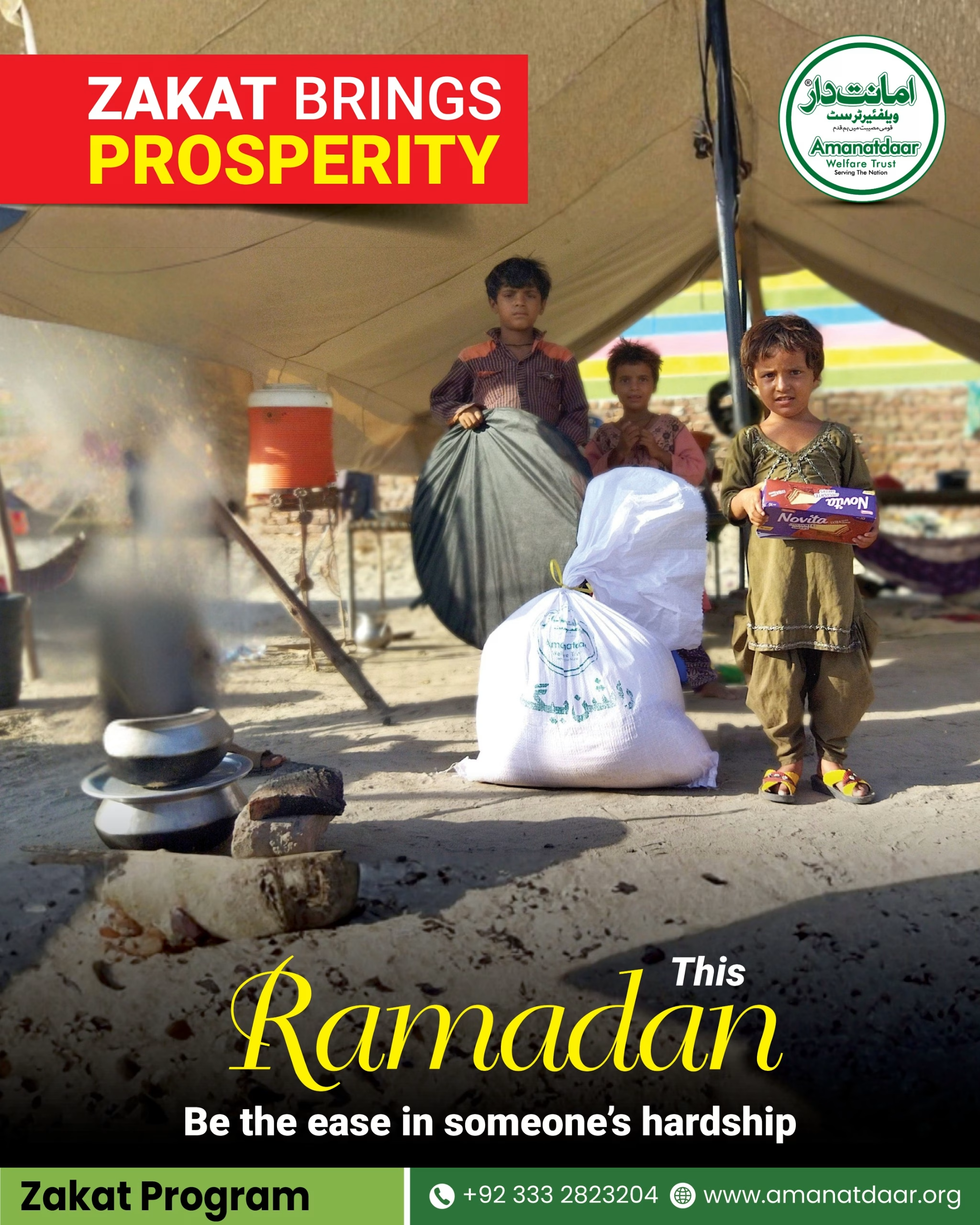
Ramadan 1448 is expected to begin around 8 February 2027 in Pakistan, and with it the month in which the Prophet ﷺ was “more generous than the blowing wind” (Bukhari). A Ramadan donation can take four forms: sponsoring iftar for fasting people, giving a month’s ration bag to a family, paying Zakat (if your Zakat date falls in Ramadan or you choose to pay early), and giving Fitrana before Eid prayer. In Pakistan in 2026, one iftar meal cost around Rs 270, a family ration bag for the month about Rs 13,200, and Fitrana a minimum of roughly Rs 250–300 per person. This guide explains what each donation does, what it costs, when in the month to give it, the rewards the Sunnah attaches to feeding the fasting, and how to make sure your giving reaches the people it is meant for.
![Rows of people breaking their fast at a Dastarkhwan iftar in Karachi at sunset]
—
The Quran describes the righteous as those who “give food, in spite of love for it, to the needy, the orphan and the captive” (Surah Al-Insan, 76:8). In Ramadan, that act takes on a specific reward. The Prophet ﷺ said: “Whoever gives iftar to a fasting person will have a reward like his, without the fasting person’s reward being reduced in the least” (Tirmidhi). Scholars note that the reward applies even to a date or a sip of water, and multiplies with every person fed.
Ramadan also multiplies the reward of all good deeds, contains Laylat al-Qadr — “better than a thousand months” (Surah Al-Qadr, 97:3) — and is the month in which most Pakistanis choose to pay their Zakat, because the bank deduction and the community’s rhythm both fall on it.
The need is real. The World Food Programme estimates that around one in five Pakistanis faces hunger, and in Ramadan food prices in Karachi routinely rise ahead of demand. For a daily-wage family, a month of fasting without a reliable iftar is a month of real hardship.
—
Donation | What it is | Obligatory? | Best timing |
Iftar sponsorship | Cooked meals for fasting people at a Dastarkhwan or delivered | Voluntary Sadaqah | Any day; last 10 nights for extra reward |
Ration bag | A month’s flour, rice, pulses, oil, sugar, tea, dates for one family | Voluntary Sadaqah, or Zakat if the family is eligible | Before or in the first week of Ramadan |
Zakat | 2.5% of zakatable wealth | Obligatory on the nisab-holder | On your Zakat date; many pay in Ramadan |
Fitrana (Zakat al-Fitr) | A fixed amount per family member | Obligatory on every Muslim with surplus food | Before Eid prayer; ideally early in Ramadan |
Fidya and Kaffarah — payments for fasts missed through illness or old age, or deliberately broken — are a fifth category for those to whom they apply; see our guide to Fidya and Kaffarah.
—
Based on 2026 programme costs in Karachi; 2027 prices will track food inflation.
Item | 2026 cost (PKR) | What it provides |
One iftar meal box | 270 | Rice or roti meal with dates and water for one person |
Iftar for 10 people | 2,700 | A table at a Dastarkhwan |
Iftar for 50 people | 13,500 | A neighbourhood iftar |
Iftar for 100 people | 27,000 | A full Dastarkhwan sitting |
Monthly ration bag, family of 5 | 13,200 | Flour, rice, pulses, oil, sugar, tea, dates — about 30 days |
Ration bags for 5 families | 66,000 | Five households through Ramadan |
Fitrana, per person (minimum) | 250 – 300 | Equivalent of ~2 kg flour; higher if you choose dates or raisins |
Fidya, per missed fast | 250 – 300 | Feeding one poor person two meals |
A useful planning benchmark: feeding one person iftar for all 30 days costs about Rs 8,100; feeding a family of five for the month through a ration bag costs about Rs 13,200. The ration bag reaches the same family every day for a fraction of the per-meal cost, which is why many donors combine a Dastarkhwan iftar for the public with ration bags for verified households.
—
An iftar drive or Dastarkhwan is a public meal served at sunset to anyone who comes — labourers, rickshaw drivers, students, the homeless, travellers — without eligibility checks, because feeding a fasting person is Sadaqah open to all. Amanatdaar’s Dastarkhwan serves more than a thousand meals a day year-round and scales up through Ramadan, with hospital and orphanage deliveries alongside the public tables.
Sponsor iftar for a specific day (an anniversary, a parent’s death date, a Friday) or a number of meals spread across the month.
Iftar can be given on behalf of a deceased relative as isal-e-sawab, or for a living family member unable to give.
Kitchens buy in bulk before Ramadan; donations in the first week let the organisation plan portions for the whole month.
Reputable trusts share daily meal counts and photos; some let you attend and serve.
Iftar donations are Sadaqah, not Zakat, because the meal goes to whoever sits down, not to a verified eligible owner. If you want to give Zakat as food, use ration bags to verified families instead.
![Volunteers packing Ramadan ration bags with flour, rice, dates and oil in a warehouse]
—
A Ramadan ration bag answers the month’s hardest problem for a poor family: sehri and iftar every day for thirty days at prices that have just gone up. Because the bag is handed to a specific family that becomes its owner, it can be funded from Zakat if the family qualifies — Muslim, below the nisab, not a dependant of the giver — and from Sadaqah if not. Our food rations distribution programme keeps the two funds separate so donors can give either.
The ideal time to give a ration bag is the last week of Sha’ban or the first days of Ramadan, so the family has it before the first sehri. Bags given after mid-Ramadan still help, but a family that has already borrowed for the first two weeks will use part of the bag to repay.
—
Zakat is due on your own Zakat date, which may or may not be in Ramadan. Paying in Ramadan is allowed in two situations: your Zakat date falls in the month, or you pay in advance for a date later in the year, which is permitted once you own the nisab. What is not allowed is delaying Zakat that was due months ago until Ramadan for the reward — Zakat is paid when due, and late payment without excuse is sinful even if the money eventually arrives.
If you do pay in Ramadan, calculate properly: all zakatable assets at that day’s value, debts due deducted, 2.5% on the net if above the nisab, minus whatever the bank deducted on 1 Ramadan. Our Zakat calculator for Pakistan walks through it in rupees and tolas. Zakat given through a trust is best given in the first half of the month, so that monthly rations, school fees and medical cases can be funded through Ramadan and Eid rather than after.
—
Zakat al-Fitr, or Fitrana, is obligatory on every Muslim who has food beyond their need on the night of Eid — adult or child, with the head of the household paying for dependants. It is due before the Eid prayer and is best given early in Ramadan so the poor can use it for Eid, as the Prophet ﷺ intended: “a purification for the fasting person from idle talk and indecency, and food for the needy” (Abu Dawud). In 2026 the minimum in Pakistan was around Rs 250–300 per person, based on roughly 2 kg of wheat flour; those who can afford more may calculate on dates, raisins or cheese, which gives a much higher figure. Our guide to Fitrana amount and rules has the detail and the 2027 figure will be updated when flour prices are announced.
—
Calculate your Zakat if your date falls in Ramadan or you plan to pay early. Give ration bags so families have them before the first sehri. Book iftar sponsorship for the dates you want.
Pay Zakat to a verified channel. Pay Fitrana for the whole household now rather than on the 29th. Sponsor a Dastarkhwan day.
Give Sadaqah for specific needs — a medical case, a student’s fees, a widow’s rent — through a trust that verifies each one.
Increase daily Sadaqah; many donors give something every night to be sure of Laylat al-Qadr. Fund extra iftar tables for the crowds of the last nights. Give Fidya or Kaffarah if applicable.
Confirm Fitrana reached the poor before Eid prayer. Consider an Eid gift fund — clothes, shoes, sweets — for the children of the families you supported.
—
Ramadan brings out thousands of appeals, and not all are what they seem. Before you give:
Our checklist on how to verify an NGO before donating covers each point in detail.
—
Through its Amanatdaar Dastarkhwan, Amanatdaar Welfare Trust serves free iftar and sehri across Karachi throughout Ramadan — at public tables, in hospitals and at orphanages — and through its food rations distribution delivers month-long ration bags to verified widows, orphans and daily-wage families. Its Zakat programme funds rations, education guardianship, medical treatment and livelihoods for eligible families, with Zakat and Sadaqah accounts kept separate. As a registered trust in Pakistan, it is audited every year, PCP-certified, and tax-exempt, and its US partner issues 501(c)(3) receipts for overseas donors.
Perspective from Amanatdaar Welfare Trust: “Ramadan is when our kitchens and our phones are busiest. The donors who help us most are the ones who give in the first week — we can buy flour and rice in bulk before prices climb, plan a thousand portions a day with confidence, and get ration bags to families before the first sehri. A donation on the 27th night is blessed; a donation on the 1st feeds people for all 27 nights.”
—
—
![A mother and children receiving a Ramadan ration bag at their door]
Pay what is obligatory first — Zakat if due and Fitrana — then give Sadaqah. Among voluntary gifts, feeding the fasting carries a specific hadith reward, and a monthly ration bag reaches one family every day of the month for the lowest cost per meal.
Around Rs 270 per meal box in 2026, so roughly Rs 2,700 for ten people and Rs 27,000 for a hundred. Prices for 2027 will follow food inflation.
Generally no, because a public iftar goes to whoever comes and no eligible person becomes its owner. Use Zakat for ration bags to verified families and Sadaqah for iftar tables.
On your own Zakat date if it falls in Ramadan, or early as advance payment for a later date. Do not delay Zakat already due from earlier in the year; pay it immediately.
Before the Eid prayer. It is best given early in Ramadan so the poor can use it for Eid. In 2026 the minimum was about Rs 250–300 per person in Pakistan.
Yes. Iftar, rations and Sadaqah can be given as isal-e-sawab for a deceased parent or relative, and the reward reaches them by Allah’s permission.
Donations to a registered charity with a recognised partner usually are. Amanatdaar’s US partner issues 501(c)(3) receipts; donors elsewhere should check their local rules.
—
Ramadan asks two things of those who can give: that the obligatory is paid on time and the voluntary is given generously. A plan made before the month begins — Zakat calculated, Fitrana set aside, ration bags booked, iftar days chosen — turns good intentions into meals on the first night rather than the last.
Give your Ramadan 2027 donation through Amanatdaar’s Dastarkhwan, ration and Zakat programmes — a registered, audited trust that feeds Karachi every day of the month and can show you where every rupee went.

Subscribe to our Newsletter. We promise not to spam you!