For Sadaqah Jariyah in Pakistan, a solar water pump is the stronger long-term investment — it serves 150–500 people for 20+ years with no electricity dependency, making it the highest reward-per-beneficiary water project available. A hand pump is the right choice when your budget is tight, the need is urgent, or the project site is a single-family or small-community setting. Both are valid, verified Sadaqah Jariyah. This guide tells you exactly which one fits your intention, your budget, and your geography.
Sadaqah Jariyah is an ongoing charity whose reward continues flowing to the donor after death, for as long as the benefit reaches others. The Prophet ﷺ named it explicitly in Sahih Muslim 1631: “When a person dies, his deeds come to an end except for three: ongoing charity (sadaqah jariyah), knowledge that is benefited from, and a righteous child who prays for him.” In Sunan Abi Dawud 1681, he ﷺ was asked what charity is best and answered: “Water.”
Water is therefore not merely a practical gift. It is the prophetically endorsed apex of Sadaqah Jariyah — every cup drawn from a pump you funded is a deed written in your favour while you sleep, travel, or have already returned to Allah.
According to WHO and UNICEF estimates, around 55% of Pakistan’s population lacks access to safely managed drinking water. WaterAid places Pakistan among the top 10 countries with the lowest access to clean water near the home. The scale of need is not abstract. It is the reality of tens of millions of Pakistanis who begin each morning walking to a contaminated source rather than turning a tap.
The table below uses 2026 PKR market rates observed across Pakistani charity and installation sources, converted at approximately PKR 280 per USD.
Factor | Hand Pump | Solar Water Pump |
Cost (PKR) | PKR 45,000–175,000 | PKR 150,000–450,000 (community scale) |
Cost (USD approx.) | $160–$625 | $535–$1,600 |
Beneficiaries | 1–30 families (15–150 people) | 100–500+ people |
Lifespan | 10–20 years (with maintenance) | 20–25 years |
Electricity dependency | None — fully manual | None — solar powered |
Maintenance | Low — washers, rods, lubrication | Low-medium — panel cleaning, pump checks |
Installation time | 1–3 days | 3–7 days |
Best geography | Shallow water table: KPK valleys, parts of Punjab, peri-urban Sindh | Deep water table, arid zones: Tharparkar, Balochistan, interior Sindh |
Islamic reward scale | Continuous per family served | Continuous per larger community served |
Zakat eligible? | Yes, if recipient qualifies | Yes, if recipient qualifies |
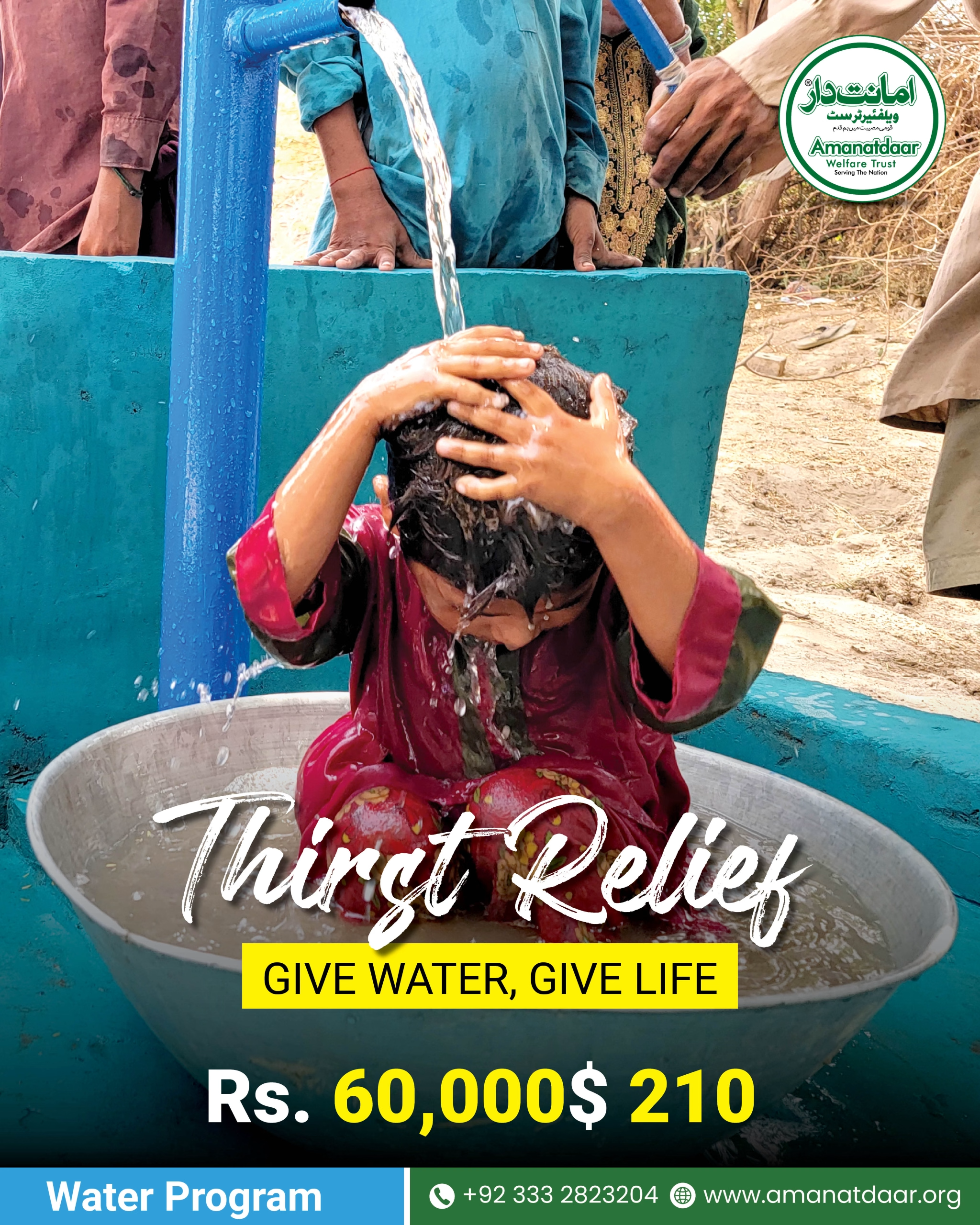
A water project in Pakistan can cost from around PKR 45,000 to PKR 60,000 for a standard hand pump, around PKR 110,000 for a heavy-duty hand pump, around PKR 150,000 for a mini solar water pump, and up to PKR 450,000 for a larger community solar water pump system.
Solar wins over grid-electric pumps for one decisive reason: Pakistan’s electricity grid cannot be trusted to run a charity water project reliably.
Consumers across Pakistan experience long hours of forced loadshedding, with urban areas facing three to six hours and rural areas enduring six to ten hours daily. In peak summer and winter stress periods, unannounced blackouts lasting 8–16 hours a day hit many areas, and in some localities power can be out for 20 hours or more per day — essentially leaving entire communities off the grid.
An electric pump installed as charity in a village in interior Sindh or Balochistan may run for only two or three hours on any given summer day. The community gets water when WAPDA decides to supply power — not when the family wakes at Fajr to fetch it. A solar pump runs on sunlight. In Tharparkar, Balochistan, and much of interior Sindh, the sun shines more than 8–9 hours a day for most of the year. That is free, reliable energy that no state-run grid can replicate for these communities.
A solar tubewell is a water pumping system powered entirely by solar panels that extracts groundwater for irrigation, livestock, and agricultural use without any grid connection or diesel generator. For a Sadaqah Jariyah donor, this means your water project delivers its benefit every single day — not only when loadshedding allows it.
The right pump depends on geography, water table depth, and community size. Here is what on-the-ground installation experience tells us.
Tharparkar is among Pakistan’s most water-stressed zones. The water table sits deep — often 80–150 metres — and surface sources are seasonal, saline, or contaminated. A standard hand pump cannot reach this depth reliably. A community solar pump with a 3–5 HP submersiblemotor is the correct choice here. Solar irradiance in Tharparkar is among the highest in South Asia, meaning panels operate at near-peak efficiency year-round. One community solar installation can serve an entire village of 200–500 people from a single bore.
Balochistan covers 44% of Pakistan’s landmass but holds a fraction of its water infrastructure. Ground water exists but lies deep, and distances between settlements mean each installation must be self-sufficient — no grid backup, no nearby technician on call. Solar is the only realistic technology for sustainable water charity here. Hand pumps can work in the few districts where the water table is shallow (under 40 metres), but for the majority of Balochistan’s arid districts, only a solar-powered deep bore system delivers consistent, year-round clean water.
KPK’s geography is more varied. In valley settlements near rivers and streams, the water table is relatively shallow and hand pumps are highly effective, cost-efficient, and fast to install. In remote highland communities — Kohistan, upper Dir, Chitral — solar pumps are again the superior choice because grid connectivity is poor or absent. For KPK generally, hand pumps offer excellent value for Sadaqah Jariyah at the family-to-small-community scale, while solar serves larger highland villages.
Punjab has the most developed grid infrastructure, but rural areas are reporting loadshedding of up to 16 hours a day. South Punjab — Rahim Yar Khan, Bahawalpur, Muzaffargarh — mirrors interior Sindh in water stress and loadshedding severity. For charity projects in South Punjab’s poorest communities, solar is increasingly the right long-term choice. In more accessible Punjab villages with shallower water tables, a quality heavy-duty hand pump remains a fast, impactful, and affordable Sadaqah Jariyah option.
The reward of Sadaqah Jariyah is not fixed at the moment of giving. It scales with use. Every person who draws water, makes wudu, gives a drink to a child, or waters livestock from your pump adds to your account with Allah. This is not a metaphor — it is the direct implication of the hadith in Sahih Muslim 1631.
Frame it practically:
These are not guaranteed theological figures — Allah alone measures reward. But the framing matters: when you choose a solar pump for a larger community, you are widening the channel through which barakah flows back to you and your loved ones every single day.
The solar pump does not replace the hand pump. It amplifies it. If your budget stretches only to a hand pump today, give the hand pump. The Prophet ﷺ did not say the best water charity is the most expensive one — he said it is water, full stop.
This is one of the most commonly misunderstood questions in Islamic giving, and it matters practically because Zakat has strict eligibility conditions.
Sadaqah Jariyah is voluntary ongoing charity. A water pump donated with the intention of ongoing benefit is Sadaqah Jariyah by definition — there are no nisab conditions, no recipient eligibility criteria beyond genuine need, and no calculation required. Any Muslim can give it at any time, in any amount.
Zakat is an obligatory annual purification of wealth. It can fund a water pump project, but only if the pump is installed to directly benefit individuals who meet the Zakat eligibility criteria (the eight categories in Surah At-Tawbah: 60), and if the funds are disbursed in a way that transfers benefit to those recipients. A pump installedin a village of eligible poor families — which describes virtually every community where Pakistani welfare organisations work — satisfies this condition.
The practical answer: You can fund a water pump with Zakat funds, Sadaqah Jariyah funds, or general voluntary Sadaqah. The pump itself becomes Sadaqah Jariyah the moment it begins serving people. Your Zakat intention purifies your obligatory wealth; your Sadaqah Jariyah intention opens an ongoing reward stream. Many donors do both — paying their Zakat through a water project and then adding a separate voluntary top-up to increase the scale of the installation.
If you want to pay Zakat in Pakistan through a verified, registered trust, or dedicate a pump as Sadaqah Jariyah Pakistan for yourself or a loved one, Amanatdaar Welfare Trust accepts both with full project documentation.
Yes — and the prophetic precedent is direct. In Sahih Muslim, a companion asked the Prophet ﷺ whether he could give Sadaqah on behalf of his deceased mother, and the Prophet ﷺ confirmed that the reward would reach her. Scholars across all four major madhabs are unanimous on this point: Sadaqah Jariyah donated with the intention that its reward be gifted to a deceased person reaches them, by the mercy of Allah.
A water pump donated in the name of a parent, spouse, or child who has passed is one of the most enduring gifts you can give them. Every time someone draws water from that pump — at Fajr, at midday, in the middle of the night — the reward flows to the person you named. There is no expiry on this. The pump runs for 15–25 years. So does the gift.
To donate in the name of a deceased loved one through a registered Pakistani nonprofit with on-the-ground installation capability, Amanatdaar Welfare Trust documents every project with photos and location confirmation so your family has a permanent record of the sadaqah given.
A water project in Pakistan can cost from around PKR 45,000 to PKR 60,000 for a standard hand pump, around PKR 110,000 for a heavy-duty hand pump, around PKR 150,000 for a mini solar water pump, and up to PKR 450,000 for a larger community solar water pump system.
Here is what those figures look like in full context:
Hand Pump — Standard (PKR 45,000–60,000 / approx. $160–$215) Covers site survey, drilling to 60–80 metres, pump head, galvanised riser pipes, concrete apron, and installation labour. A medium pump typically serves 15 to 20 families, while a heavy-duty pump can support up to 25 to 30 families. Suitable for shallow water table areas. Fastest to deploy — hand pumps usually take 1–2 days to install.
Hand Pump — Heavy Duty (PKR 95,000–175,000 / approx. $340–$625) For areas with a deeper water table, a heavy-duty hand pump costs around 95,000 PKR, reflecting the extra piping, the more powerful pump head, and the specialised drilling rigs needed to cut through difficult soil layers.
Solar Water Pump — Community Scale (PKR 150,000–450,000 / approx. $535–$1,600) Covers solar panels, submersible motor, VFD inverter or direct-drive controller, mounting structure, bore drilling, pipework, storage tank, and installation. Serves 100–500+ people. Lifespan 20–25 yearswith minimal recurring cost. No electricity bills. No fuel. The sun is the only running cost — and it charges nothing.
Shared Contribution Options Not every donor can cover a full installation alone. A shared family hand pump contribution usually starts around PKR 4,500, a half sponsorship ranges from PKR 22,000 to PKR 25,000, and a complete family hand pump generally costs around PKR 45,000. Pooled giving for a solar pump allows a diaspora family in the USA to contribute $50–$100 toward a community installation that serves hundreds — every contributor receives the ongoing reward proportional to their share.
A pump installed and then abandoned is not Sadaqah Jariyah — it is a monument to wasted intention. Maintenance and community ownership are what keep the reward flowing.
Hand pump maintenance is genuinely low-cost and locally manageable. Local caretakers can be trained to handle basic maintenance like replacing leather washers or lubricating parts. Spare parts for standard Pakistan Mark-II and India Mark-II type pumps are available in any district market for a few hundred rupees. A well-maintained hand pump realistically lasts 15–20 years.
Solar pump maintenance requires slightly more technical knowledge for inverter checks and panel cleaning, but has fewer moving parts than a hand pump overall. The submersible motor is sealed underground and protected from dust and weather. Solar panels require periodic cleaning — in Tharparkar and Balochistan, dust accumulation is the primary maintenance task, manageable by any community member. After the initial payback period, a solar system runs free for 20–25 years.
The critical factor in both cases is community ownership. Amanatdaar Welfare Trust’s field approach involves registering a local community water committee before installation — a named group of residents who take responsibility for the pump, manage minor repairs, and report issues. This single step is what separates a pump that lasts 20 years from one that breaks in 18 months.
Expert perspective from Amanatdaar Welfare Trust, a registered Pakistani nonprofit based in Karachi:
No UK-based charity, however well-intentioned, can replicate what a Karachi-headquartered organisation delivers in the field. Amanatdaar Welfare Trust operates directly across Pakistan — not through distant intermediaries — channelling Zakat, Sadaqah, and general donations into clean water, food, education, healthcare, widow support, and emergency relief. When a pump is installed under the Amanatdaar name, the field team is Pakistani, the supply chain is Pakistani, and the accountability runs back to a registered charity Pakistan with verifiable certificates, a named board of trustees, and a Karachi office donors can contact directly.
For Pakistani diaspora donors in the USA sending money home for water projects, this matters enormously. Your donation does not pass through a London office that sub-contracts to a Lahore partner that sub-contracts to a village contractor. It moves through a single trusted chain — Amanat, the Arabic root of the trust’s name, meaning something held in sacred trust. That is not branding. It is a founding commitment.
Explore Amanatdaar’s charity projects Pakistan including water, food rations, free mobile clinics, widow support, and education — or go directly to donate a handpump in Pakistan to begin your Sadaqah Jariyah today.
A solar water pump delivers more total reward over time because it serves more people for longer — typically 100–500+ beneficiaries over 20–25 years versus 15–30 families over 10–20 years for a hand pump. For communities in water-scarce regions like Tharparkar or Balochistan, solar is clearly superior. For urgent, small-community needs or tighter budgets, a hand pump is a fully valid and immediately impactful Sadaqah Jariyah. The best pump is the one you can actually fund and install.
In 2026, a standard hand pump costs around PKR 45,000 to PKR 60,000, a heavy-duty hand pump around PKR 110,000, a mini solar water pump around PKR 150,000, and a larger community solar water pump system up to PKR 450,000. Shared contributions toward any of these projects start from as low as PKR 4,500, making water Sadaqah Jariyah accessible at almost any giving level.
Yes. The prophetic precedent in Sahih Muslim confirms that Sadaqah given on behalf of a deceased person reaches them. Scholars across all four major madhabs affirm this. Donating a water pump in the name of a parent, spouse, or child who has passed is among the most enduring gifts in Islamic giving — the reward flows to them every time someone uses the pump, for the entire lifespan of the installation.
It is both, depending on your intention and the recipient’s eligibility. A water pump donated voluntarily is Sadaqah Jariyah — ongoing charity with no conditions attached. If the pump is installed for communities whose members meet the Zakat eligibility criteria (the eight categories in Surah At-Tawbah: 60), the same project can be funded with Zakat. Most rural Pakistani communities where charity pumps are installed satisfy Zakat eligibility. Consult a qualified scholar if you are uncertain about your specific situation.
A hand pump is a manually operated mechanical device that draws groundwater from shallow depths — typically up to 60–80 metres — using human effort, with no electricity or fuel required. A solar water pump uses photovoltaic panels to power a submersible electric motor, drawing water from greater depths automatically during daylight hours. Hand pumps cost less and deploy faster; solarpumps serve larger communities, reach deeper water tables, and operate for longer with lower maintenance burden per beneficiary served.
With high-grade materials, hand pumps typically stay functional for 15 to 20 years. A quality solar pump system — panels, inverter, and submersible motor — has a functional lifespan of 20–25 years under normal operating conditions. Lifespan in both cases depends heavily on material quality at installation and the presence of a community maintenance arrangement. A cheap pump with no maintenance plan may fail within 18 months; a quality pump with an active community water committee will run for two decades.
A community solar water pump in a deep water table, high water-stress region — Tharparkar in Sindh, interior Balochistan, or South Punjab — delivers the highest measurable impact per donation rupee over a 20-year horizon. It serves the most people, requires no recurring utility cost, and is immune to loadshedding. For immediate, verifiable family-level impact at low cost, a heavy-duty hand pump in a water-scarce KPK or Punjab village is the highest-impact entry-level water charity project available in Pakistan in 2026.
Yes — this is established by direct prophetic hadith and unanimous scholarly consensus. In Sahih Muslim, the Prophet ﷺ confirmed that Sadaqah given on behalf of a deceased mother reaches her. There is no time limit — you can give on behalf of someone who passed years or decades ago. A water pump, a solar installation, or even a shared contribution toward a larger water project all qualify. The reward is gifted to the deceased by your sincere intention at the moment of giving.
The question of solar water pump vs hand pump for Sadaqah Jariyah Pakistan does not have a single answer — it has a principled framework. Solar wins on total impact, longevity, and reward per beneficiary, particularly in Pakistan’s water-stressed provinces and against the backdrop of a loadshedding crisis that makes grid-electric pumps an unreliable charity investment. Hand pumps win on speed, accessibility, and budget — and they remain a perfectly honoured Sadaqah Jariyah in the sight of Allah.
What matters most is that you give. The Prophet ﷺ said water is the best sadaqah. He did not place a minimum on it.
Amanatdaar Welfare Trust is a registered charity Pakistan operating from Karachi with verified NGO credentials, transparent project documentation, and direct field operations across Pakistan’s most water-deprived communities. Whether you want to donate a handpump in Pakistan for a family, dedicate a solar installation as Sadaqah Jariyah Pakistan for a deceased parent, or explore the full range of charity projects Pakistan — clean water, food rations, healthcare, education, and widow support — the trust is built to carry your amanat faithfully to those who need it most.

Subscribe to our Newsletter. We promise not to spam you!