Imagine a good deed that keeps earning you reward long after you’ve given it — even after you’ve left this world. That is the extraordinary promise of Sadaqah Jariyah, the “ongoing charity” that the Prophet Muhammad (peace be upon him) described as one of only three things that continue benefiting a person after death.
Whether you’re giving for yourself, dedicating reward to a deceased parent, or building a legacy that outlives you, this guide explains what Sadaqah Jariyah means, the most powerful examples, and how to start one today in Pakistan.
Sadaqah means voluntary charity; Jariyah means flowing, running, or continuous. Together, Sadaqah Jariyah means a charity whose benefit — and therefore whose reward — continues to flow for as long as people keep benefiting from it.
A single meal feeds someone once; the reward is earned once. But a water well serves a village for twenty years — and every sip drawn from it adds to the giver’s scale of good deeds, day after day, year after year.
The foundation of this concept is the famous hadith narrated by Abu Hurairah (may Allah be pleased with him), in which the Prophet (peace be upon him) said:
“When a person dies, all their deeds come to an end except three: Sadaqah Jariyah (ongoing charity), beneficial knowledge, or a righteous child who prays for them.” (Sahih Muslim)
This hadith reshapes how a believer thinks about wealth. Everything we spend on ourselves ends with us — but what we plant in ongoing charity becomes a spiritual pension that pays out for generations.
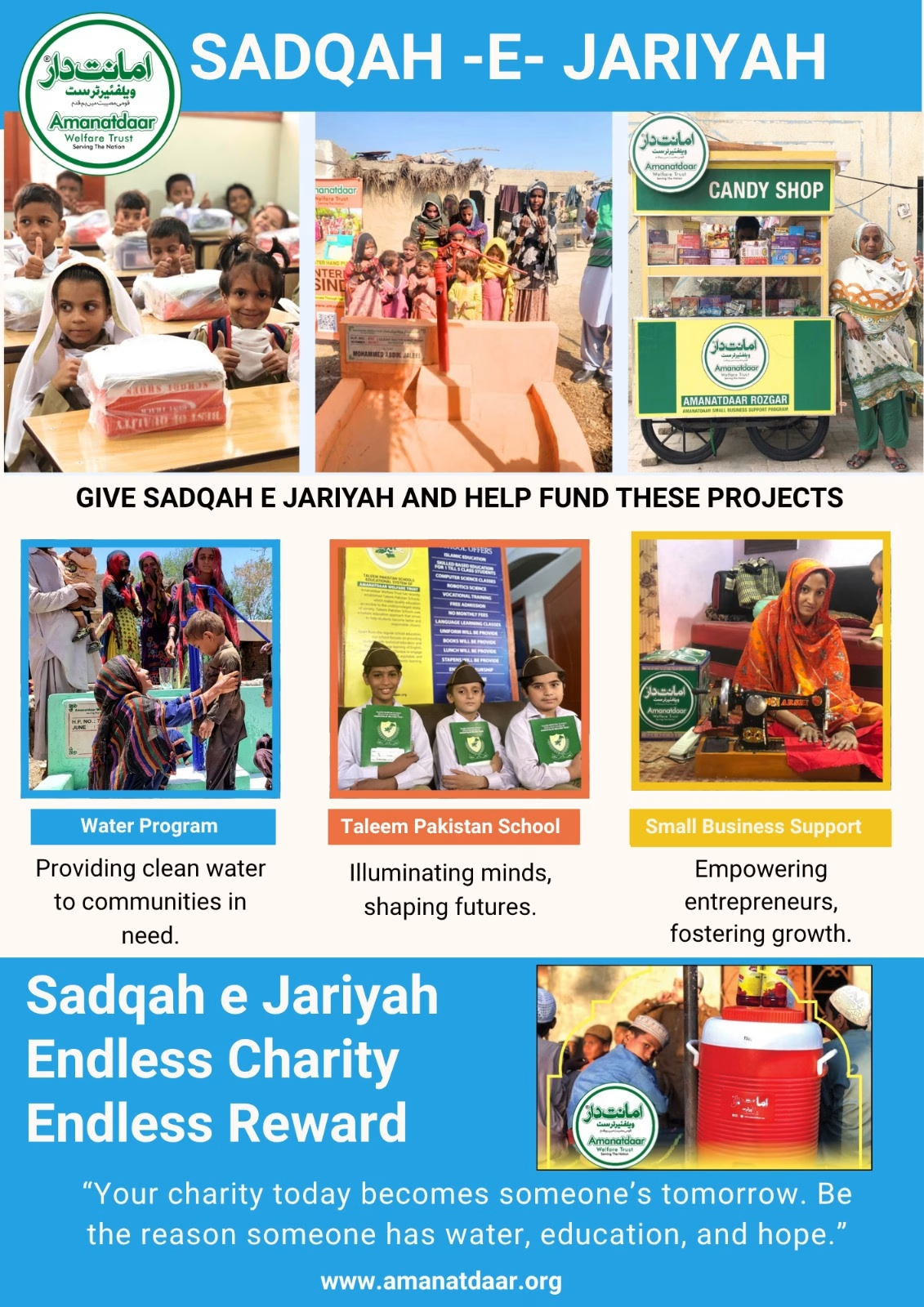
Water is the classic Sadaqah Jariyah — when the Prophet (peace be upon him) was asked which charity is best, he replied: “Providing water.” In rural Sindh and Balochistan, where only around a third of people have reliable access to clean water, a single handpump donation transforms an entire village: children stop walking hours for water, waterborne disease drops, and every drop drawn is written in your book of deeds.
For areas where drilling isn’t feasible, water coolers and jerry cans provide continuous clean-water access as an equally ongoing benefit.
Knowledge is explicitly named in the hadith. When you fund a child’s schooling, every word they read, every skill they use, and everything they teach others multiplies your reward. Through Amanatdaar Schools, underprivileged children in Pakistan receive quality education to international standards — and with 22.8 million children out of school in Pakistan, few investments carry greater ongoing impact.
Helping a child memorise the Quran may be the most beautiful Sadaqah Jariyah of all: every verse they recite for the rest of their life traces back to your support. Amanatdaar’s Hifz Sponsorship program covers the education and care of Hifz students — a legacy of Quran that never stops reciting.
The Prophet (peace be upon him) promised closeness to him in Paradise for the one who cares for an orphan. Supporting an orphan’s education, health, and well-being through Education Support and Well-being for Orphans shapes an entire life — and every good that child goes on to do carries your share of reward.
Give a family food and you feed them for a week; give them a livelihood and you feed them for life. Amanatdaar’s Small Business Support program equips deserving individuals — widows, the unemployed, struggling fathers — with carts, sewing machines, shop stock, and equipment. Every honest rupee they earn afterwards is ongoing charity credited to you.
Contributing to mosques, schools, and institutions of beneficial knowledge serves worshippers and students for decades, generating continuous reward with every prayer and lesson.
The Prophet (peace be upon him) said that when a Muslim plants a tree, whatever is eaten from it is charity for them. Sustainable projects that keep producing benefit — orchards, food programs with lasting infrastructure — fall within this beautiful category.
One of the most common questions Muslims ask is: Can I give Sadaqah Jariyah on behalf of someone who has passed away? The answer is a resounding yes.
In a well-known hadith, a companion asked the Prophet (peace be upon him): “My mother has died; will it benefit her if I give charity on her behalf?” He replied: “Yes.” (Bukhari)
Giving Sadaqah Jariyah for deceased parents, grandparents, or loved ones means:
A handpump installed in your late father’s name, a Hifz student sponsored for your mother, or an orphan educated in memory of a loved one — these are gifts that reach them where no flowers can. Explore Amanatdaar’s dedicated Sadaqah Jariyah program to dedicate a project in a loved one’s name.
Ongoing charity for parents deserves special mention, because it works in both directions of time:
While your parents are alive, giving Sadaqah Jariyah in their honour — with their knowledge or as a gift — brings them joy, earns them reward, and fulfils the Quranic command of ihsan (excellence) towards parents. A handpump gifted on a parent’s retirement, or a scholarship in their name, is a gift no material present can rival.
After they pass away, Sadaqah Jariyah becomes one of the few remaining channels through which a child can still serve their parents. The hadith of the man who asked about charity for his deceased mother — answered with a simple “yes” — has comforted grieving children for fourteen centuries. Combined with your dua (the third deed in the famous hadith), ongoing charity keeps your relationship with your parents spiritually alive.
Many Amanatdaar donors establish a yearly tradition: one dedicated project per deceased parent, renewed every Ramadan — a rhythm of remembrance that steadily builds their parents’ account in the hereafter.
With so many options, choose based on three factors:
Sadaqah Jariyah is not only for the wealthy. Ongoing charity scales to every budget:
Whatever the amount, the key is the continuity of benefit — and the sincerity behind it.
Ongoing charity requires an organisation that will still be maintaining that benefit years from now. Amanatdaar Welfare Trust — a registered Pakistani charity (No. 217), PCP-certified, and a US 501(c)(3) nonprofit — has delivered:
You can even see the human side of these numbers in our transformative stories — real families whose lives were changed by ongoing charity.
What are the 3 deeds that continue after death? According to the hadith in Sahih Muslim: ongoing charity (Sadaqah Jariyah), beneficial knowledge, and a righteous child who prays for the deceased.
What is the best Sadaqah Jariyah? Providing water is singled out in hadith as the best charity, making wells and handpumps the most beloved choice. Education and Quran memorisation sponsorship are equally profound, combining charity with beneficial knowledge.
Can Sadaqah Jariyah be given from Zakat money? Zakat has strict recipient rules and must be owned by eligible individuals, so most Sadaqah Jariyah projects should be funded from voluntary charity, not Zakat. Some programs, like supporting eligible orphans and students, can qualify under both — Amanatdaar clearly marks which programs are Zakat-applicable.
Can I give Sadaqah Jariyah while I’m alive for my own self? Absolutely — and it’s the wisest time to give. The Prophet (peace be upon him) taught that the best charity is what you give while healthy, hoping for wealth and fearing poverty.
Every day you delay is a day of flowing reward missed. Choose your legacy — water, knowledge, an orphan’s future, a family’s livelihood — and set it in motion today.
Begin your ongoing charity through Amanatdaar’s Sadaqah Jariyah program, or give instantly via the Instant Donation Box. The reward starts flowing the moment you do.
Subscribe to our Newsletter. We promise not to spam you!