Pakistan has made slow but measurable progress in literacy over the past decade. Yet more than one in three people aged 10 and above still cannot read and write with understanding, and millions of children remain out of school.
This article breaks down the latest literacy rate in Pakistan, compares provinces, genders and age groups, explains why the numbers remain low, and looks at what government, charities and ordinary citizens can do to change them.
According to the Household Integrated Economic Survey (HIES) 2024-25 published by the Pakistan Bureau of Statistics, and repeated in the Pakistan Economic Survey 2025-26, Pakistan’s literacy rate for people aged 10 and above is 63 percent. This is up from around 60 percent in 2018-19.
In Pakistan, a literate person is officially defined as someone who can read a newspaper and write a simple letter in any language, and can perform simple calculations.
Indicator | Rate (HIES 2024-25) |
|---|---|
Overall literacy (age 10+) | 63% |
Male literacy | 73% |
Female literacy | 54% |
Youth literacy, age 15-19 | 79% |
Out-of-school children (share) | 28%, down from 30% |
The gender gap of nearly 20 percentage points is one of the widest in South Asia. Encouragingly, younger age groups show much higher literacy, which means that today’s classrooms are slowly changing the national picture.
Literacy varies sharply between provinces. HIES 2024-25 shows the following comparison with 2018-19:
Province | 2018-19 | 2024-25 | Change |
|---|---|---|---|
Punjab | 64% | 68% | +4 |
Sindh | 57% | 58% | +1 |
Khyber Pakhtunkhwa | 55% | 58% | +3 |
Balochistan | 40% | 49% | +9 |
Pakistan | 60% | 63% | +3 |
Balochistan recorded the largest improvement but still has the lowest rate in the country. Sindh, home to Karachi, has improved only marginally, and its rural districts lag far behind the urban centres. Across Pakistan, rural women remain the group least likely to be literate.
Literacy tomorrow depends on enrolment today. HIES 2024-25 found that the share of out-of-school children aged 5 to 16 fell to 28 percent. Federal planning minister Ahsan Iqbal noted at the survey launch that Pakistan still has roughly 25 million out-of-school children, one of the highest numbers in the world.
Girls are more likely to be out of school than boys, and the gap widens at middle and secondary level, when distance to school, safety, cost and early marriage all push girls out of education.
When a family struggles to buy food, school fees, uniforms, books and transport become impossible. Pakistan’s national poverty rate rose to about 29 percent in 2024-25, and in poor households children are often sent to work instead of school.
The Pakistan Economic Survey shows combined federal and provincial education spending fell to just 0.8 percent of GDP in FY2025, far below the 4 percent benchmark recommended by UNESCO.
In many rural areas, primary schools exist but middle and high schools are far away. Parents are reluctant to send daughters long distances, so girls’ education often ends after Grade 5.
Even children who attend school do not always learn to read with understanding. Teacher shortages, absenteeism and rote learning mean that enrolment does not automatically translate into literacy.
A 2026 national report by the National Commission for Human Rights and UNICEF found that around 8.6 million children in Pakistan are in child labour. Every working child is a child at risk of never becoming literate.
Lasting change needs government investment, but charities and individuals play a powerful role in closing the gaps the state cannot reach quickly.
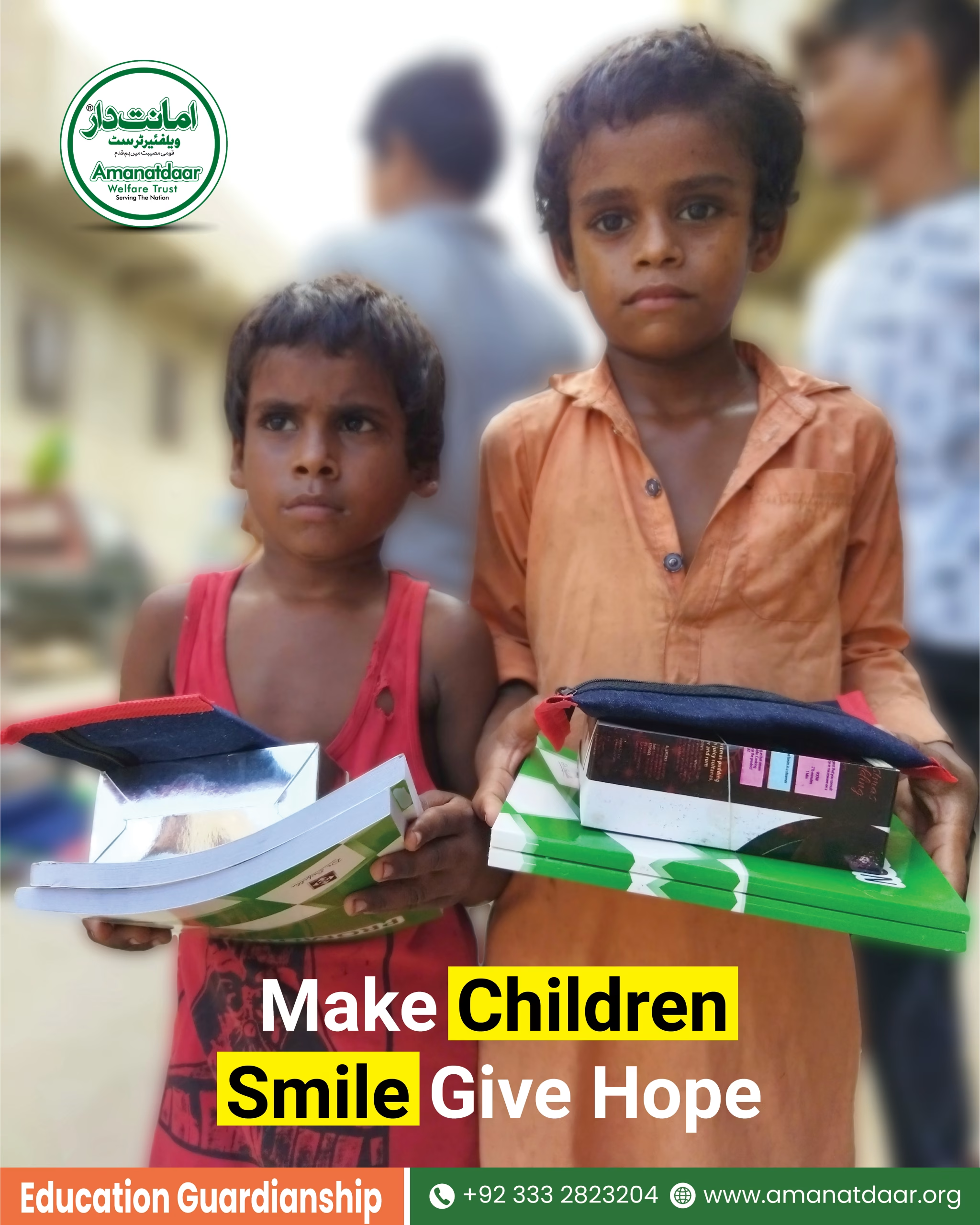
Give a Child the Gift of Reading Your support can keep an underprivileged child in school for a full year. Sponsor a student through Amanatdaar or give any amount through our Instant Donation Box. Our audited annual reports show exactly where your money goes. |
The latest official figure is 63 percent for people aged 10 and above, from the HIES 2024-25 released by the Pakistan Bureau of Statistics and cited in the Pakistan Economic Survey 2025-26.
Female literacy is 54 percent, compared with 73 percent for males, according to HIES 2024-25.
Punjab has the highest literacy rate at 68 percent, followed by Sindh and Khyber Pakhtunkhwa at 58 percent each. Balochistan has the lowest at 49 percent.
About 28 percent of children aged 5 to 16 are out of school, which is roughly 25 million children according to government statements in 2026.
A person aged 10 or above who can read a newspaper, write a simple letter in any language and do simple calculations is considered literate.
Subscribe to our Newsletter. We promise not to spam you!