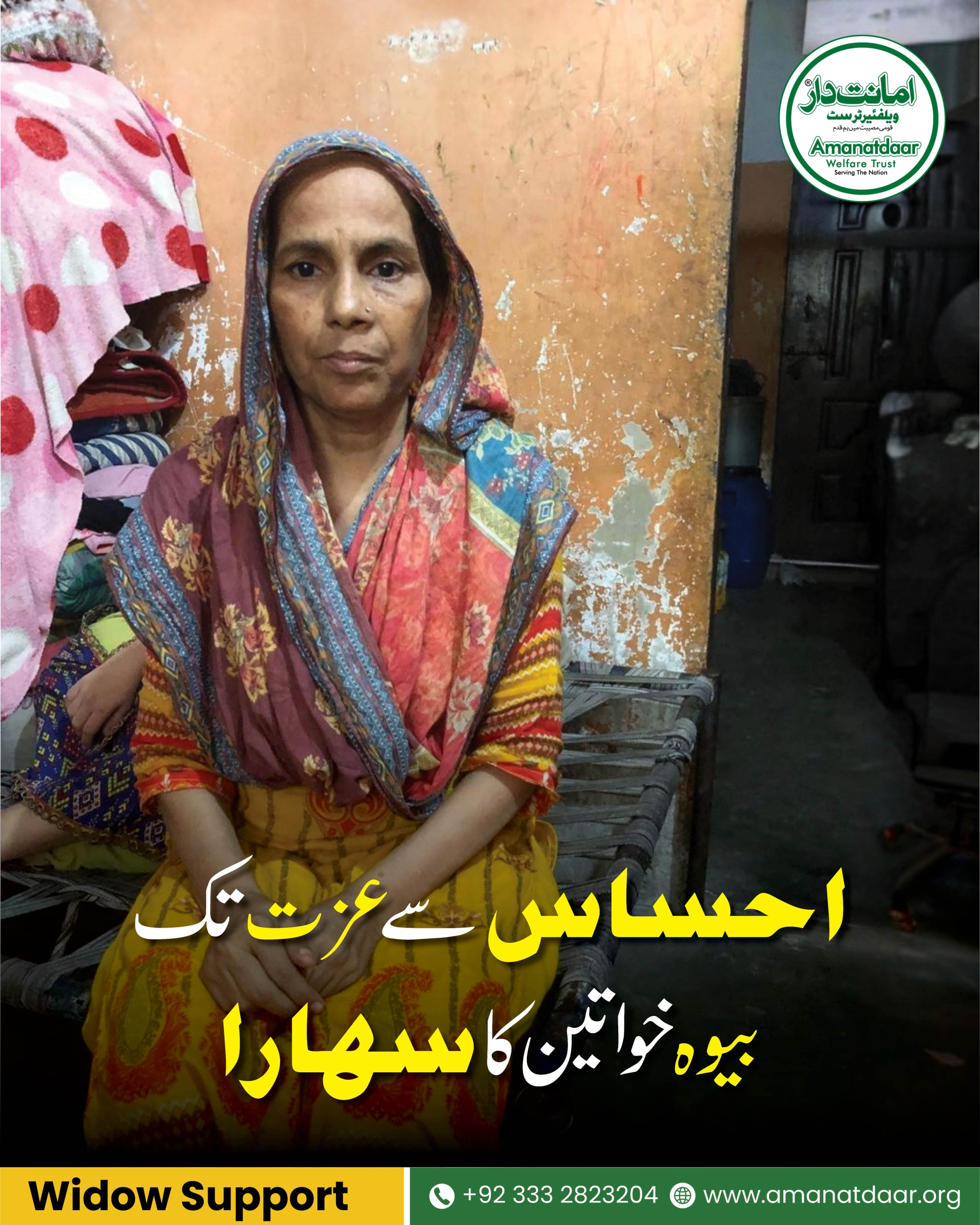
Pakistan is home to an estimated 3–5 million widows, the majority of whom fall below the poverty line within months of losing their husbands. Government programmes like BISP and Pakistan Bait-ul-Mal provide a partial floor, but they leave enormous gaps in income, food security, healthcare, and children’s education. Registered charities fill those gaps through six proven intervention types — and your Zakat, Sadaqah, or general donation can be directed to each one.
Widows are among the most economically vulnerable people in Pakistan — and the numbers behind that statement are not abstract.
Pakistan’s 2023 census recorded a total population of 247,541,947. Male life expectancy stands at 66.8 years versus 71.6 years for females — meaning millions of women statistically outlive their husbands by years. Pakistan Bureau of Statistics Labour Force Survey data shows that among women aged 65 and above, roughly 37% are recorded as widowed or widowers. Applied to a population of this size, that translates to several million widows at any given time, predominantly concentrated in low-income rural and peri-urban communities.
The economic backdrop makes their situation especially severe. Pakistan’s poverty rate reached 25.3% in 2024 — a sharp increase of seven percentage points compared to 2023, adding approximately 13 million people to the impoverished population, according to a World Bank report. Widows, who lose the household’s primary earner overnight, are disproportionately represented in that figure.
Widowhood in Pakistan triggers a cascade of interlocking vulnerabilities that go far beyond grief.
In most Pakistani households, the husband is the sole or primary earner. When he dies, income stops immediately. There is rarely savings, insurance, or a pension. A widow with children can find herself unable to pay rent, buy food, or keep children in school within weeks.
Islam grants women a defined share of inheritance — yet the reality on the ground is starkly different. According to a survey by Awaz Foundation Pakistan, a staggering 86% of Pakistani women are being denied their share in inheritance. Many families pressure women to forego their inheritance rights “for the sake of family harmony,” and 70% of Pakistani women don’t ask for their share in inheritance due to the fear of losing their family. For widows, this denial is catastrophic: it removes the one asset — property or land — that could provide long-term security.
Widowhood brings adverse psycho-social impacts irrespective of gender; however, among the elderly population, old women in general and widows in particular are more vulnerable. The stigma attached to widowhood and the resultant social isolation further limit their access to communal support, markets, and labour networks, which are critical for livelihood resilience.
Cultural norms in many parts of Pakistan restrict women’s ability to travel alone, access government offices, or negotiate with employers. Combined with a national literacy rate of 60.7% (2023 census), many widows lack the skills to navigate bureaucratic registration processes or access formal employment.
Pakistan has three main government-level programmes that widows can access. Each provides genuine but limited relief.
The Benazir Income Support Programme (BISP) is Pakistan’s largest cash transfer scheme and the most accessible safety net for widows. The Unconditional Cash Transfer programme, also known as the Benazir Kafaalat Programme, was initiated in 2008 and has grown to become the largest single cash transfer programme in Pakistan’s history.
The 2025 update now includes widows, persons with disabilities, and transgender individuals in the eligibility list to ensure equal access to financial support. In February 2026, BISP announced a raise in financial aid ahead of Ramadan; the Benazir Khawateen Kafalat Program boosted the quarterly payment by Rs. 1,000, bringing the total to Rs. 14,500 per beneficiary. That works out to approximately Rs. 4,833 per month — enough to cover a fraction of a family’s basic food costs, but nothing more.
BISP eligibility requirements for widows:
The limitation: BISP’s quarterly payment is not indexed to inflation. BISP transfers are not indexed to inflation, making them lose purchasing power over time.### What Is Pakistan Bait-ul-Mal Widow Support?
Pakistan Bait-ul-Mal (PBM) is a federal body established specifically to support those the Zakat system does not reach. PBM was established in February 1992 under the Pakistan Bait-ul-Maal Act of 1991, created to work for the welfare of widows, orphans, disabled, needy and poor people irrespective of sex, caste, creed or religion — with the primary purpose of providing assistance to vulnerable segments of society not covered by Zakat.
PBM runs two programmes most directly relevant to widows:
Orphan and Widow Support Programme (OWSP): The OWSP is a conditional cash transfer programme, initiated in 2020 as a pilot, providing family support such as education and healthcare to orphans and widows — with payments tied to conditions such as keeping children in school or attending health check-ups.
Individual Financial Assistance (Medical): This programme supports the poor, widows, destitute women, orphans and disabled persons for treatment of major illnesses, with assistance of up to Rs. 1 million for conditions including cancer, heart disease, hepatitis, and kidney dialysis, released on hospital recommendation.
Since 1995, Pakistan Bait-ul-Mal has been operating 165 Women Empowerment Centres (WEC) across Pakistan, including AJK and Gilgit Baltistan, aiming to train widows, orphans, and poor girls in professional and income-generating skills, empowering them to become financially independent. Trainees receive a stipend of Rs. 50/day based on attendance, with local market-oriented courses tailored according to the region’s needs with support from NGOs and community stakeholders.
The honest limitation of government programmes: Even taken together, BISP, PBM, and the WECs reach only a fraction of Pakistan’s widows. BISP payments are too small to cover rent and food simultaneously. PBM’s OWSP is still in pilot phase in many districts. WEC stipends of Rs. 50/day amount to roughly Rs. 1,300/month — below any realistic cost of living. The verification process for all three is slow, documentation-heavy, and geographically uneven. This is precisely the gap that charities exist to fill.
Registered charities delivering widow support Pakistan operate across six distinct intervention types. Each addresses a specific layer of vulnerability.
The most direct intervention: a recurring cash or in-kind transfer to cover essential household expenses. At Amanatdaar Welfare Trust, the anchor cost for this support is PKR 12,000 per month (approximately $33 USD at current rates).
What does PKR 12,000 actually provide?
Expense | Estimated Monthly Cost (PKR) |
Basic food staples (flour, rice, lentils, oil) | 5,000–6,000 |
Utilities (electricity, gas, water) | 1,500–2,500 |
Children’s school supplies and transport | 1,000–2,000 |
Basic medicines and household essentials | 1,000–1,500 |
Total covered | ~8,500–12,000 |
For a diaspora donor in the USA, $33/month — less than a single restaurant meal — sustains a widow and her children for an entire month.
Many widows cannot wait for a monthly stipend to be processed. Emergency and regular food ration donation Pakistan programmes deliver pre-packedration bags containing flour, rice, lentils, cooking oil, sugar, and tea — enough to feed a family of four to five for a month. This is often the first point of contact between a newly widowed woman and a charity’s support network, and it builds the trust needed for longer-term enrolment.
When a father dies, the first casualty is often the children’s schooling. Fees, uniforms, books, and transport become unaffordable overnight. Charities address this through direct school fee payments, stationery provision, and in some cases full sponsor a child Pakistan scholarships that keep children enrolled from primary through secondary level. Keeping children in school also protects against child labour and early marriage — two of the most common downstream consequences of widowhood poverty.
A stipend creates dependency; a skill creates independence. Effective widow support programmes invest in sewing, embroidery, mobile phone repair, basic computing, beauty therapy, and home-based food production — trades a woman can practise within her home if mobility is restricted. The goal is to move a widow from recipient to micro-earner within six to eighteen months. Small business support Pakistan programmes that provide a starter toolkit or micro-grant alongside training dramatically accelerate this transition.
Widows disproportionately delay or forgo medical treatment due to cost and the absence of a male escort in conservative communities. Charities bridge this through subsidised clinic visits, medicine provision, and mobile health camps that come directly to underserved neighbourhoods. Amanatdaar’s healthcare charity Pakistan programme and free mobile clinic service specifically target communities where widows and their children cannot easily access fixed health facilities.
This is the intervention type most consistently absent from government programmes and most consistently underestimated by donors. Grief, social isolation, anxiety about the future, and the trauma of sudden financial collapse create a mental health burden that, left unaddressed, undermines every other form of support. Reputable charities embed case workers — often women from the same communities — who conduct regular home visits, facilitate peer support groups, and connect widows with Islamic counselling where appropriate.
This is one of the most common questions from Pakistani and diaspora donors, and the answer matters because it affects both your religious obligation and how the charity can use your funds.
Yes — and this is one of the clearest applications of Zakat in classical Islamic jurisprudence. Zakat is obligatory on every Muslim whose net wealth exceeds the nisab threshold. The nisab for 2026 is approximately PKR 503,529 (approximately USD 1,810) based on the gold standard. Muslims pay 2.5% of their qualifying wealth as Zakat.
A widow who has no independent income and whose total assets fall below nisab is unambiguously among the fuqara (the poor) and masakin (the needy) — two of the eight categories named in Surah At-Tawbah (9:60) as eligible recipients. When you pay Zakat in Pakistan through a verified charity, the trust is legally and religiously responsible for ensuring those funds reach only nisab-eligible beneficiaries. Amanatdaar Welfare Trust conducts household verification before enrolment specifically to confirm Zakat eligibility.
Important distinction: Zakat funds must be transferred as ownership to the recipient — they cannot be used for overhead, building projects, or endowments. This means Zakat is ideal for monthly stipends and food rations but cannot fund, say, a water pump installation.
Sadaqah (voluntary charity) carries no nisab requirement andno restriction on how it is used. It can fund vocational training centres, school buildings, medical equipment, or any programme that benefits a widow and her family. It is the most flexible giving channel and is accepted from donors of any wealth level at any time of year.
Sadaqah Jariyah — ongoing charity whose reward continues after the giver’s death — is particularly powerful when directed toward widow support. A handpump installed in a community where widows draw water, a classroom built in a school their children attend, or a sewing machine provided to a widow who then earns from it for years: all of these qualify. Many diaspora donors give Sadaqah Jariyah Pakistan in the name of a deceased parent, making widow support a bridge between honouring the dead and protecting the living.
Quick reference table:
Giving Type | Who Must Give | Can Fund | Cannot Fund |
Zakat | Muslims above nisab, annually | Stipends, food rations, direct cash to eligible widows | Buildings, overheads, endowments |
Sadaqah | Anyone, any amount, any time | Any programme or service | Nothing — fully flexible |
Sadaqah Jariyah | Anyone | Lasting assets: water, schools, equipment | Consumable one-off relief |
General Donation | Anyone | Any programme | Nothing — fully flexible |
Farida (name changed to protect identity) is a 38-year-old widow in Karachi’s Orangi Town. Her husband, a daily-wage labourer, died of a sudden cardiac episode, leaving her with three children aged 5, 9, and 13. Within two weeks, she had exhausted the small amount of cash in the house. Her in-laws, citing the absence of a formal will, refused to share any property. She was not registered with BISP — her husband had always handled documents — and she did not know where the nearest BISP office was.
A neighbour referred her to a local charity network. Within ten days, a caseworker had visited her home, assessed her household, and enrolled her in a monthly stipend programme. A ration bag arrived the same week. Her 9- and 13-year-olds, who had stopped attending school, were enrolled in an education sponsorship scheme. Six months later, Farida joined a tailoring skills cohort. By month nine, she was taking small stitching orders from her neighbourhood.
The PKR 12,000 monthly stipend did not make Farida wealthy. It kept her children fed while she rebuilt. That is exactly what it is designed to do — and it is what $33 from a donor in the USA makes possible every single month.
Amanatdaar Welfare Trust is a registered charity Pakistan based in Karachi, channelling Zakat, Sadaqah, and general donations into food, education, healthcare, clean water, widow support, and emergency relief across Pakistan.
From the perspective of Amanatdaar Welfare Trust: “Every widow we support has already survived the hardest moment of her life. Our role is not to hand her charity indefinitely — it is to stand beside her long enough that she no longer needs us. We verify each beneficiary personally, deliver support with dignity, and track progress from first contact to self-sufficiency. The trust placed in us by donors — the meaning of Amanatdaar itself — demands nothing less.”
The Trust’s widow support process follows five steps:
The Trust’s charity programmes Pakistan span widow support, food rations, education, healthcare, clean water, and emergency relief — meaning a single enrolled widow can access multiple layers of help without being referred elsewhere.
If you are part of the Pakistani diaspora in the United States, your donation carries particular weight. The PKR-USD exchange rate means even a modest monthly commitment delivers substantial on-the-ground impact.
Donating through a Pakistani-registered nonprofit like Amanatdaar is straightforward:
Amanatdaar Welfare Trust is a registered nonprofit in Pakistan. US-based donors should note that donations to foreign charities are generally not deductible on a US federal tax return unless the organisation holds 501(c)(3) status or the gift is made through a qualifying US-based intermediary. Consult a tax advisor for your specific situation. The spiritual and humanitarian value of the giving, of course, is not contingent on its tax treatment.
Diaspora donors sometimes ask why they should give through a Pakistan-registered charity rather than a large international NGO. The answer is operational proximity. A Karachi-based trust like Amanatdaar reaches the narrow lanes of Orangi Town and Lyari where international organisations rarely have ground presence. Verification is personal, delivery is direct, and overhead is lower. You can view the Trust’s registration, trademark, and certificates at the registered NGO Pakistan page before you give.
Widows in Pakistan can access financial support through three main channels: government programmes (BISP’s Benazir Kafaalat quarterly payment, currently Rs. 14,500; Pakistan Bait-ul-Mal’s Orphan and Widow Support Programme); registered charities that provide monthly stipends, food rations, and skills training; and community Zakat distribution through mosques or verified trusts. To access BISP, send your CNIC to 8171 via SMS and visit your nearest Tehsil office. To access charity support, contact a registered welfare trust operating in your area.
Charities deliver six core types of support that government programmes do not fully cover: monthly financial stipends, food and ration bags, children’s school fee sponsorship, vocational and skills training, subsidised or free healthcare, and psychosocial support through community caseworkers. The best programmes combine multiple intervention types for a single beneficiary, addressing income, nutrition, education, and health simultaneously rather than treating each in isolation.
A widow’s daughter is generally not independently eligible for a government family pension in Pakistan. Under federal and provincial pension rules, the widow herself (as spouse) is the primary beneficiary of a deceased government employee’s pension. Dependent children may receive a share only if the widow is also deceased or remarries, and eligibility varies by province and employer. Daughters are typically excluded once they marry. Widows should contact the relevant pension authority — federal, provincial, or armed forces — directly to confirm the rules applicable to their husband’s specific employment.
Yes. A widow whose total assets fall below the nisab threshold (approximately PKR 503,529 based on gold, or lower based on silver, for 2026) is among the fuqara and masakin — two of the eight Zakat-eligible categories in Surah At-Tawbah (9:60). Zakat given through a verified charity must be transferred as direct ownership to the recipient. Amanatdaar Welfare Trust conducts household verification before enrolment to confirm nisab eligibility, ensuring your Zakat obligation is properly discharged.
BISP helps widows through its Benazir Kafaalat Programme, an unconditional quarterly cash transfer currently set at Rs. 14,500 per quarter (approximately Rs. 4,833/month) as of March 2026. Widows are a priority category. Eligibility requires a valid CNIC, a poverty score below the programme threshold assessed via the NSER dynamic survey, and no government pension or employment. Check eligibility by sending your CNIC to 8171. Payments are collected via biometric verification at partner bank agents, ATMs, JazzCash, or Easypaisa.
Pakistan’s widows face six compounding challenges: sudden loss of the household’s primary income; inheritance denial (research by Awaz Foundation Pakistan indicates 86% of Pakistani women are denied their inheritance share); social stigma and isolation that limits access to markets and support networks; restricted mobility under patriarchal cultural norms; low literacy that creates barriers to navigating government registration; and inadequate, fragmented safety nets that rarely cover all basic needs simultaneously.
Sadaqah Jariyah is ongoing voluntary charity whose spiritual reward continues after the donor’s death. For widow support, it applies to lasting assets rather than consumable relief — a sewing machine that enables a widow to earn for years, a classroom her children attend, or a handpump providing clean water to her community. It is commonly given in the name of a deceased parent or loved one. Unlike Zakat, it carries no nisab requirement and can be given in any amount at any time.
Visit Amanatdaar Welfare Trust’s donation forms page at amanatdaar.org/donation-forms, select the widow support programme, and complete payment using an international card in USD. The Trust is a registered Pakistani nonprofit; US tax deductibility depends on your individual circumstances and whether a qualifying US intermediary is used — consult a tax advisor. Your donation is acknowledged with a receipt, and the PKR/USD exchange rate means even $33/month funds a full month of stipend support for one widow and her children.
Pakistan’s widows do not lack resilience — they lack resources and access. Government programmes like BISP and Pakistan Bait-ul-Mal provide a floor, but the gap between that floor and a dignified, stable life is wide. Registered charities bridge it through verified, personal, multi-layered support: a stipend that keeps the lights on, rations that keep children fed, a skill that eventually makes both unnecessary.
The barakah in this giving is real. The Prophet ﷺ said: “The one who looks after a widow or a poor person is like a warrior fighting for Allah’s cause” (Bukhari). Whether you are a donor in Karachi or a member of the Pakistani diaspora in the USA deciding where your Zakat lands this year, the most important step ischoosing a trust that verifies its beneficiaries, delivers with accountability, and measures outcomes — not just intentions.
Amanatdaar Welfare Trust does exactly that. To help widows in Pakistan through a Karachi-based, registered, and verified charity — whether through Zakat, Sadaqah Jariyah, a monthly sponsorship, or a one-time gift — visit the Trust’s widow support programme page and give with confidence that every rupee reaches the woman it was meant for.
Subscribe to our Newsletter. We promise not to spam you!