To verify an NGO in Pakistan before donating, check five government registries in order: the SECP eZfile portal for a Section 42 licence, your provincial Social Welfare department, the PCP certified list at pcp.org.pk, FBR NPO status under Section 2(36) of the Income Tax Ordinance 2001, and the EAD NGO portal at ngo.ead.gov.pk. Then confirm audited accounts, named leadership, an organisational bank account, and a professional online presence — and ask one direct due-diligence question. Any NGO that cannot satisfy all ten points should not receive your Zakat or Sadaqah.
Donation scams in Pakistan spike during Ramadan, flood emergencies, and Eid. According to Pakistan Centre for Philanthropy, the number of active NGOs in the country is anywhere between 100,000 and 150,000, yet so far only around 2,000 NPOs have been certified. That gap — more than 98,000 unverified organisations — is where fraud lives. This checklist closes it.
Pakistan’s civil-society sector is enormous by any global measure. With at least 100,000 to 150,000 active NGOs and roughly 2,000 PCP-certified ones, the certified fraction is well under 2 percent. No single government portal lists every registered charity; verification requires cross-referencing at least three to five separate registries at federal and provincial level. The registration framework for NGOs in Pakistan involves multiple regulatory authorities, including SECP, the Ministry of Interior, EAD, provincial authorities, and FBR. For overseas donors — particularly the Pakistani diaspora in the USA — an additional EAD MOU check is legally required before sending funds across borders. None of that complexity is the donor’s fault, but ignoring it“`markdown makes your Sadaqah vulnerable to misuse — and that is a responsibility Islam places squarely on the giver.
SECP registration is the minimum legal proof that a Pakistani nonprofit exists as a formal entity. For NGOs aiming for credibility and a robust legal structure, Section 42 of the Companies Act provides a crucial pathway — it is a special licensing regime overseen by the Securities and Exchange Commission of Pakistan (SECP), designed specifically for the formation of companies that operate on a not-for-profit basis.
How to verify: Go to https://www.secp.gov.pk and use the eZfile portal’s Company Name Search. In 2024, SECP launched the eZfile portal, replacing the older eServices system, providing a more user-friendly interface and streamlined company registration and compliance filings. Search the NGO’s exact registered name. A legitimate Section 42 entity will appear with a company number, incorporation date, and status marked “active.” If no record appears, or the status reads “struck off,” stop.
What to look for: The words “Section 42 Licence” or “Not-for-Profit” against the entity type. Note the registration number — you will need it for the FBR check in Step 4.
Provincial Social Welfare registration is required for NGOs operating at community level. All NGOs are required to register with their local Voluntary Social Welfare department. Submit the MoA, bylaws, and application to the Social Welfare Department of your province — Punjab, Sindh, KPK, Balochistan, or ICT.
Where to look by province:
Province | Department | Portal / Contact |
Sindh | Directorate of Social Welfare & Bait-ul-Mal | sindh.gov.pk/dept/SWD |
Punjab | Punjab Social Welfare Department | swd.punjab.gov.pk |
KPK | Directorate of Social Welfare | kp.gov.pk/page/social_welfare |
Balochistan | Social Welfare Department | balochistan.gov.pk |
ICT (Federal) | Capital Administration & Development Division | cadd.gov.pk |
Ask the NGO for its provincial registration certificate number and cross-reference it directly with the relevant department. A Karachi-based charity, for example, must be registered with the Sindh Social Welfare Directorate.
PCP certification is the single most rigorous quality mark available to a Pakistani nonprofit. The PCP Certification Program awards accreditation to non-profit organisations that demonstrate excellence in seven functional areas, and seeks to bring transparency, accountability, and good governance to the nonprofit sector in Pakistan — involving evaluation on standardised parameters of financial management, programme delivery, and internal governance.
Pakistan Centre for Philanthropy (PCP) is a designated Certification Agency by the Federal Board of Revenue (FBR), Government of Pakistan. That designation matters: PCP certification is the gateway to FBR NPO tax-exempt status (Step 4).
How to search: Visit https://cmis.pcp.org.pk — PCP’s Certification Management Information System — and search by organisation name. The full directory is also browsable at https://www.pcp.org.pk/Directory.html. A certified organisation will show a valid certification date and renewal status. Certification is not permanent; confirm the certificate is current.
Registration with PCP is not obligatory for working in Pakistan, and therefore not all NGOs will be recorded on the PCP Certified CSO list —but the absence of PCP certification on a large, well-funded NGO is a yellow flag worth investigating further.
FBR NPO status under Section 2(36) of the Income Tax Ordinance 2001 is what makes a donation fiscally and — for many scholars — religiously valid. NGOs must obtain clearance under Section 2(36) of the Income Tax Ordinance from the FBR. Donors to registered NGOs have been provided with tax relief under Section 61 of the Income Tax Ordinance — this section encompasses tax credit advantages that can lower an individual’s taxable income by a maximum of 30% and a company’s by 20%.
For Zakat specifically, the Islamic obligation requires that funds reach eligible recipients (the eight asnaf categories defined in Surah At-Tawbah 9:60). An FBR-approved NPO has already demonstrated to the government that it operates for charitable purposes and maintains clean books — which is the closest documentary proof available that your Zakat will be channelled correctly.
How to verify: Go to https://www.fbr.gov.pk and use the Active Taxpayer List (ATL) search, or search the Income Tax SRO notifications for approved NPOs. The full list is accessible on the FBR portal under Income Tax SROs. Cross-reference the NGO’s NTN (National Tax Number) against its SECP registration to confirm they belong to the same legal entity.
Non-profit organisations (NPOs) are allowed 100% tax credit under the local tax law, subject to certain conditions and limitations specified therein. An NGO without this status is not legally recognised as a charity by Pakistan’s tax authority — full stop.
EAD registration is non-negotiable for any Pakistani NGO that receives money from abroad. There is a legal requirement for certain NPOs/NGOs to also be registered with the Federal Government of Pakistan through the Economic Affairs Division (EAD) of the Ministry of Finance; where an NGO registered in Pakistan is interested in receiving foreign contributions — money, services, and goods sourced from outside Pakistan — it must enter into a Memorandum of Understanding (MOU) with the EAD.
The MOU is valid for up to three years, and renewable for a further period of two years. An expired MOU means the NGO is currently operating outside the legal framework for foreign contributions.
How to verify: Visit https://ngo.ead.gov.pk — the official EAD NGO e-Portal. Search the registered NGO name to confirm active MOU status. EAD itself recommends that EAD-approved NGOs be selected for any foreign contributions.
For USA-based Pakistani donors: Your remittance is a “foreign contribution” the moment it crosses the border. Sending money to an NGO without a valid EAD MOU puts both you and the organisation in a legally grey area. Additionally, donors living outside Pakistan are eligible for tax credit if they donate to an NPO registered in Pakistan and/or with simultaneous registration in the USA or the UK. To claim a US tax deduction, donate through a US-registered 501(c)(3) intermediary that has an active grant relationship with the Pakistani NGO — direct transfers to a foreign entity do not qualify under IRS rules.
Note: individual contributions by Pakistani diaspora for charitable purposes not exceeding US$10,000 per transaction and US$120,000 per year are exempt from the MOU requirement under the EAD policy — but the receiving NGO must still be legitimately registered.
A legitimate NGO publishes audited financial statements annually — anything less is a governance failure. The audit must be conducted by an external, independent firm registered with the Institute of Chartered Accountants of Pakistan (ICAP). A self-prepared “financial summary” posted on social media is not an audit.
What to look for in the report:
Ratio | Healthy range | Red flag |
Programme spend vs total expenditure | 75% or above | Below 60% |
Administrative / overhead costs | Under 20% | Above 35% |
Fundraising costs | Under 15% | Above 25% |
Surplus carried forward | Modest, explained | Exceeds 25% of annual income (triggers FBR tax) |
NGOs with EAD registration must submit annual project reports and audited financial statements to EAD. Ask for the most recent copy. If the NGO refuses, or the last audit is more than 18 months old, treat that as disqualifying.
Most nonprofits must maintain proper accounting records and prepare annual financial statements — transparent reporting strengthens organisational credibility and reduces regulatory risks.
A trustworthy NGO has nothing to hide about who runs it. Every SECP-registered Section 42 company must list its directors and trustees on public record. Requirements include complete details and CNIC of office bearers, a list of three bearers duly signed with phone number, email, and permanent address as per CNIC, and a verifiable office address in a commercial area with a lease agreement or ownership proof.
How to verify: Search the NGO’s name on the SECP eZfile portal — the directors’ names are part of the public company record. Then cross-check those names against the NGO’s own website. If the website lists anonymous “our team” tiles with no surnames, CNICs, or professional bios, ask directly. A registered charity has no legal reason to hide the identities of its trustees.
Never transfer Zakat, Sadaqah, or any donation to a personal bank account, personal JazzCash wallet, or personal Easypaisa number. The NGO must maintain a dedicated Pakistani bank account and inform the bank of EAD approval for smooth crediting of funds. The account name on the transfer screen must match the organisation’s registered legal name exactly.
Fraudsters operate by luring victims through fake accounts and impersonating identities — once trust is established, they ask for funds through fake financial accounts. Scammers frequently clone the names of legitimate charities and circulate personal wallet numbers in WhatsApp groups, particularly during Ramadan and flood emergencies. One mismatch between the account name and the registered NGO name is sufficient reason to stop the transaction entirely.
A legitimate NGO’s digital footprint is coherent, stable, and transparent. Run through this quick checklist:
Fraudsters now use WhatsApp, Facebook, Instagram, SMS, phone calls, fake websites, and even artificial intelligence to target everyday citizens. A polished TikTok video of a child in distress, posted from an account created three weeks ago, is not evidence of a legitimate organisation.
Ask this: “Can you share your SECP registration number, your most recent audited financial report, and your PCP certification status?”
A legitimate NGO answers within 24–48 hours with documents, not deflections. Strong governance is critical for long-term sustainability and donor confidence — well-governed organisations are significantly more likely to attract donor funding and strategic partnerships. An organisation that responds with vague reassurances, religious appeals without documentation, or hostility to due diligence is telling you everything you need to know. Transparency is not a burden for a trustworthy charity; it is a point of pride.
These patterns are Pakistan-specific and missing from every competing guide.
WhatsApp and TikTok emergency campaigns with personal wallet numbers. The National Cyber Crime Investigation Agency (NCCIA) has taken down organised cybercrime gangs involved in WhatsApp scams, fake Facebook profiles, and fraudulent digital payment accounts via JazzCash and other means. Donation fraud follows the same infrastructure. If a “charity campaign” circulates a personal JazzCash or Easypaisa number, it is almost certainly not a registered organisation.
Sound-alike organisation names. Scammers register names that closely resemble established charities — one letter changed, a word reordered, or “Pakistan” appended. Always search the exact name on SECP and compare the registration number with what the organisation publishes on its own website.
Seasonal-only NGOs. An organisation that appears online in Ramadan or immediately after a flood and has no activity record outside those windows has not built the institutional infrastructure that legitimate welfare work requires. Check the SECP incorporation date and the earliest social media post date.
No Urdu-language content. Any Pakistani charity genuinely serving underprivileged communities in Pakistan produces material in Urdu. English-only appeals targeting diaspora wallets, with no Urdu presence, indicate the organisation’s primary audience is donors — not beneficiaries.
Unaudited “impact numbers.” Claims like “we fed 10 million families last Ramadan” with no audited report, no third-party verification, and no named field locations are fabrications until proven otherwise.
Sending money from the United States to a Pakistani charity requires two steps beyond the core ten above.
First, confirm the EAD MOU is active (Step 5 above) — this is your assurance that Pakistani banking and regulatory authorities have vetted the organisation for cross-border fund receipt.
Second, for a US tax deduction, your donation must go through a US-registered 501(c)(3) that has a formal grant or programme relationship with the Pakistani NGO. Direct wire transfers to a foreign nonprofit do not qualify as charitable deductions under IRS rules. Donors living outside Pakistan are eligible for tax credit if they donate to an NPO registered in Pakistan and/or with simultaneous registration in the USA or the UK. Ask the Pakistani charity whether it has a US partner or fiscal sponsor, and request that organisation’s EIN number before donating.
The most honest thing a charity can do is walk donors through the verification checklist against itself. Here is how Amanatdaar Welfare Trust — a registered Karachi-based nonprofit channelling Zakat, Sadaqah, and general donations into food, education, healthcare, clean water, widow support, and emergency relief — satisfies each point.
Step | What to check | Amanatdaar’s status |
1 | SECP Section 42 registration | Registered; certificate publicly displayed |
2 | Provincial Social Welfare registration | Sindh Social Welfare registration held |
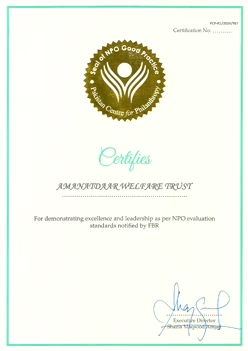
3 | PCP certification | Certification pursued; current status visible on NGO recognition Pakistan page |
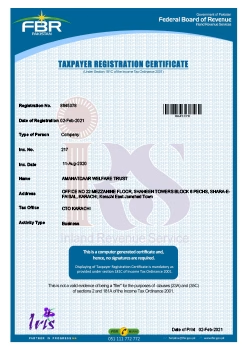
4 | FBR NPO Section 2(36) status | Active taxpayer; NTN held |
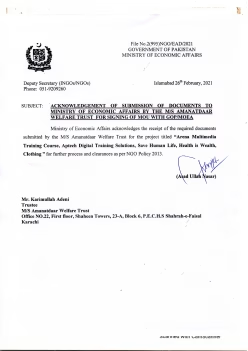
5 | EAD MOU | Active MOU for foreign contributions including diaspora remittances |
6 | Audited annual report | External ICAP-registered auditor; reports available on request |
7 | Named, verifiable leadership | Full trustee and founder profiles on the Amanatdaar team page |
8 | Organisational bank account | All donations received in the Trust’s registered account name only |
9 | Consistent online presence | HTTPS website, active multi-year social media, Urdu and English content, physical Karachi office address |
10 | Responds to due-diligence questions | Documentation provided promptly; charity FAQs Pakistan page answers common donor questions publicly |
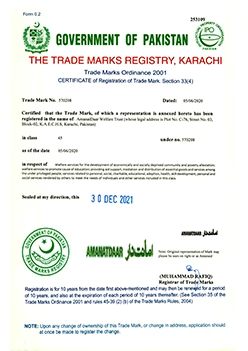
Every certificate and registration document Amanatdaar holds is displayed openly on its registered NGO Pakistan certificates page — not locked behind an enquiry form, not summarised in a social media post. That transparency is the practical definition of amanah (trustworthiness), which is the value the Trust is named after.
“The Islamic concept of amanah — holding something in trust — applies as much to the donor as to the charity. When a well-meaning person gives Zakat to an unverified organisation, the spiritual and financial responsibility for that misuse does not disappear simply because the intention was good. At Amanatdaar Welfare Trust, we actively encourage every donor to run us through this checklist. If a charity discourages your questions, that reluctance is itself the answer. Pakistan’s regulatory stack — SECP, PCP, FBR, EAD — exists precisely so that givers can give with certainty, and recipients can receive with dignity. Verification is not suspicion; it is stewardship.”
— Amanatdaar Welfare Trust, Karachi (registered Pakistani nonprofit operating charity programmes Pakistan across food, education, healthcare, clean water, and emergency relief)
Search the organisation’s exact name on the SECP eZfile portal at secp.gov.pk to confirm a valid Section 42 licence and active status. Then cross-check with your relevant provincial Social Welfare department. An NGO that does not appear on both registries has not completed basic legal registration and should not receive donations.
The Securities and Exchange Commission of Pakistan (SECP) is the regulatory authority responsible for corporate registration, governance, and compliance in Pakistan — any business entity, whether a private limited company, public company, or non-profit organisation, must register with SECP to operate legally. To check an NGO, visit secp.gov.pk, open the eZfile portal, and use the Company Name Search function. A registered nonprofit will appear as a Section 42 company with an active licence, incorporation date, and company number. No listing means no legal registration.
Yes — it is the most rigorous voluntary quality mark in Pakistan’s nonprofit sector. The PCP Certification Program awards accreditation to organisations that demonstrate excellence in seven functional areas, evaluating financial management, programme delivery, and internal governance on standardised parameters. PCP is also the designated Certification Agency of the Federal Board of Revenue (FBR), Government of Pakistan, which means its assessments carry formal regulatory weight, not just reputational value. Search the certified list at cmis.pcp.org.pk.
A legitimate Pakistani charity should readily provide: its SECP Section 42 certificate with company number; its provincial Social Welfare registration certificate; its PCP certification (if held); its FBR NTN and NPO approval letter under Section 2(36); its most recent externally audited financial statements; and the names and CNICs of its trustees or directors. Strong governance is critical for long-term sustainability and donor confidence. Any reluctance to share these documents is a red flag.
A Zakat-eligible NGO must satisfy two conditions simultaneously: it must be legally registered and FBR-approved as an NPO under Section 2(36) of the Income Tax Ordinance 2001, and it must demonstrably direct funds to one or more of the eight asnaf categories — the poor, the destitute, those in debt, travellers in need, and others defined in Surah At-Tawbah. NGOs must obtain clearance under Section 2(36) of the Income Tax Ordinance from the FBR, which requires a certificate of purpose and registration from the Pakistan Centre for Philanthropy (PCP). Ask the organisation explicitly which asnaf categories its programmes serve and request the audited evidence.
Run all ten steps in this checklist, with particular attention to Step 5. Any NGO registered in Pakistan that receives foreign contributions — money, services, and goods sourced from outside Pakistan — must have a signed MOU with the EAD. Verify that MOU at ngo.ead.gov.pk. For a US tax deduction, donate via a US-registered 501(c)(3) intermediary with a formal programme relationship with the Pakistani NGO, and request that organisation’s IRS EIN number before transferring funds.
The clearest red flags are: a personal JazzCash or Easypaisa number presented as the donation account; fraudulent digital payment accounts used in WhatsApp-based scam operations are a documented pattern in Pakistan; a name closely resembling a known charity with one word changed; an organisation that only appears online during Ramadan, floods, or Eid with no prior activity record; no SECP listing on the public portal; no Urdu-language content for a charity claiming to serve Pakistani communities; and refusal or evasion when asked for registration documents.
PCP certification and FBR NPO status confirm legal and governance credibility, but Zakat validity is ultimately a matter of Islamic jurisprudence, notgovernment registration. Scholars broadly agree that the giver must exercise due diligence — tahqiq — to confirm funds will reach eligible recipients from the recognised asnaf categories. A PCP-certified, FBR-approved NGO with audited accounts showing the majority of spend on direct beneficiary programmes provides the strongest available documentary evidence that your Zakat obligation is being discharged responsibly. For personal certainty, consult a qualified Islamic scholar alongside completing this checklist.
Verifying a Pakistani NGO before donating is not a bureaucratic formality — it is an act of amanah, the same quality of trustworthiness your donation is meant to embody. Pakistan’s regulatory framework gives donors five cross-referenceable registries, a rigorous independent certification programme through PCP, and a foreign-funding oversight mechanism through EAD. Used together, these tools make it entirely possible to give with full confidence, whether you are donating from Karachi or California.
The ten steps in this checklist take under an hour for any legitimate organisation and reveal a fraudulent one almost instantly. Run them every time — for every charity, every Ramadan, every flood appeal, without exception.
If you are ready to give to a charity that has already passed every point on this list, explore Amanatdaar Welfare Trust’s donation programmes — from food ration bags and mobile health clinics to widow support and clean water handpumps. Your Zakat and Sadaqah deserve a home built on verification, not just goodwill.
Subscribe to our Newsletter. We promise not to spam you!